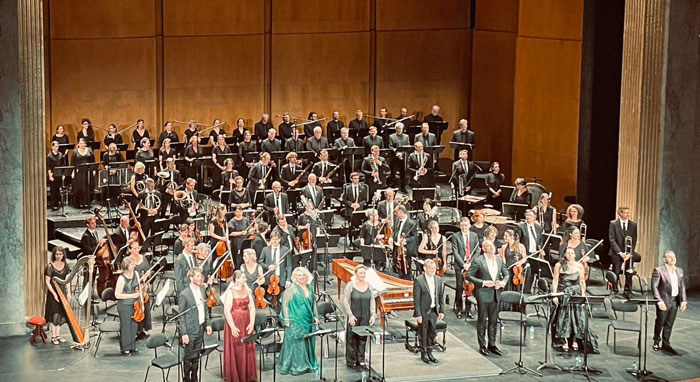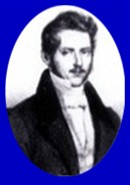




Louise Bertin's FaustoThéâtre des Champs-Elysées, Paris, June 20, 2023 Alan Jackson / Charles Jernigan, July 2023 On June 20, 2023, two Donizetti Society members, Alan Jackson and Charles Jernigan, attended a concert performance of Louise Bertin’s Fausto at Paris’ Théâtre des Champs-Elysées. A recording of the performance should be released at some point by Palazzetto Bru Zane, who organised it. Goethe’s Faust, Parts One and Two provided inspiration for several composers in the nineteenth century: Berlioz, Gounod, Schumann, Liszt and Boito among them. But the first Faust opera based on Goethe’s great verse drama was by a French woman, Louise Bertin. She also wrote her own libretto in French but then set it to music in an Italian translation by Luigi Balocchi. The opera was first staged at the Théâtre-Italien (Salle Favart) in Paris on March 7, 1831 Although in general agreement about the performance, their views of Bertin’s score itself varied considerably. Their reviews can be read below. Charles also wrote a short biography of Bertin and a commentary on the opera. [ Note that back in 2001, Douglas Bennett wrote about another Bertin opera, Esmeralda (see here) as well as a concert performance of it with piano in 2002 (see here.) Günter Gruber also provided a review of the same performance in German (see here). There were also two historic accounts of the opera: one on its performance in 1836 by Henry Chorley (see here)and one on its costumes and performance history by Charles Nuitter in French (see here). In 2008, Douglas reviewed a concert performance with full orchestra (see here)and, in 2022, Charles Jernigan reviewed Bertin's Le Loup-Garou at Alberquerque (see here) ]
Fausto at the Théâtre des Champs-Elysées
I wish I could be more enthusiastic about this latest revival of a hitherto forgotten work. But both the opera itself and this performance disappointed me considerably. From where I was sitting, front centre of the First Balcony, the orchestra overpowered the singers, especially the two female leads, Karine Deshayes in the title role (a trouser role originally conceived for Benedetta Rosmunda Pisaroni) and Karina Gauvin as Margarita. Both have estimable reputations, the latter especially in baroque music, but Deshayes often didn’t come through the orchestral sound and Gauvin sounded frankly out-of-sorts. All through the balance between voices and orchestra was very much in favour of the orchestra, Les Talens Lyriques conducted by Christophe Rousset. Maybe the balance will be better on the forthcoming recording for the Palazzetto Bru Zane label (planned for release in January 2024). Maybe a staged performance with the orchestra in its pit would have remedied the problem. And maybe the cause is partly in the music itself. It seemed to me as though Bertin was determined at all costs to avoid sounding like Rossini, who would at this time (1831) still have been the dominant figure at the Théâtre Italien and wanted to pay tribute to her musical studies with Fétis and Reicha. It sounded to me as though much of the time virtually the whole orchestra was playing which made its contribution both loud and dense. True, the three trombones (one of a few echoes of Mozart’s Don Giovanni) didn’t play continuously but outside of recitatives this was my impression. Apparently, Berlioz was accused of having written some of the music for Bertin’s last opera Esmerelda, but whereas Berlioz’s orchestration sounds brilliant and transparent, Bertin’s, as heard here, just sounded thick. The Mefistofele of Croatian bass Ante Jerkunica fared much better in the audibility stakes – he has sung a number of Wagner roles – and Nico Darmanin’s entry as Valentino at the start of Act III did acknowledge Rossini. I was fleetingly reminded of Corradino’s entry in Matilde di Shabran; even if Valentino’s high notes and runs were probably less extreme, at least he had some. Elsewhere there was an almost total avoidance of coloratura in Bertin’s vocal writing. I wondered if other musical influences might have been Cherubini and Spontini. There were few stand-alone arias and few cues for applause, and there was much ensemble work giving a through-composed feel. From the characters’ names one can infer that a knowledge of Gounod’s opera provides a good start to following the plot of Fausto. There are differences but more similarities. I would love to be able to sound more positive. The discovery of a new opera from this period, and one from a female composer, whets the appetite, but on this occasion my hunger remained unsatisfied. I should add that although applause during the opera and at the end of the first half was limited, that at the end was warm and protracted.
The public performance on June 20 by the soloists and Les Talens Lyrique led by Christophe Rousset seemed underrehearsed to me. The principal singers (with the exception of Mefistofele) always had their noses buried in their scores. The orchestra was continuously loud, often drowning out the soloists. Surely Bertin did not intend such an uneven balance. The orchestra (about 45 players) included a harp, three trombones and several horns. Placed on the stage, they over-dominated the hall. They made a loud noise unto the Devil! Without access to the score, however, I cannot say what Bertin’s dynamic markings were, but it is hard to imagine that almost all of it was marked “fortissimo.” The decision to use Bertin’s original idea and cast Fausto as a mezzo-soprano was valid and interesting, but I would like to hear it with a tenor too. Karine Deshayes, a regular with Palazzetto Bru Zane, became better—and more audible—as the performance progressed. The same cannot be said of Karina Gauvin (Margarita), a baroque specialist, who frequently could not be heard over the orchestra and did not always seem up to the music. Ante Jerkunica was a powerful-voiced Mefistofele, and he seemed more at ease with his role than the other principals. I think that Nico Darmanin, the tenor Valentino, was good and handled the one bel canto bravura moment in the opera, replete with high notes and ornaments, well, but he too was often hard to hear over the noisy orchestra. Marie Gautrot (Catarina), Diana Axentil (Una strega/Marta) and Thibault de Damas (Wagner) were fine and the Flemish Radio Chorus did their bit. It would have been nice to have all the singers comfortable enough with their roles so that they might have acknowledged each other if not actually act, but too often they were too concerned with getting their notes right instead of suggesting the passion and emotion in the music. My impressions of the music are based on a single hearing and are therefore subject to change. We will have to wait for the recording in January, 2024, to judge with more accuracy; as one contemporary critic noted, Bertin’s score deserves more than one hearing. Presumably there were pre-performance recording sessions, and the balance between singers and orchestra will be electronically adjusted; then opera lovers can decide for themselves about the music: was Louise Bertin a talented amateur or an unjustly forgotten composer of innovative music? The large and enthusiastic audience at the Théâtre des Champs-Élysées, seemed to like both the performance and the opera. The applause sounded long after that final cymbal crash signaled that the music was over. |