
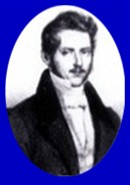




Louise BertinCharles Jernigan, July 2023 Charles wrote this
short biography in conjunction with
his
commentary on Bertin's opera, Fausto and
On June 20, 2023, a modern audience in Paris had another chance to answer those questions when the Palazzetto Bru Zane in collaboration with the Théâtre des Champs-Elysées, the orchestra Les Talens Lyrique and the chorus of Radio Flamande offered a concert performance of Fausto, which had enjoyed only three performances almost 200 years ago before the season ended—and was not revived. Fausto is a unicum in many ways. First of all, as far as I can ascertain, it was the first opera to be based on Goethe’s Faust. (Louis Spohr’s 1816 singspiel Faust was based on the medieval legends, not Goethe’s 1808 verse play, Faust, Part. One.) Gérard de Nerval’s French prose translation of Faust, Part One appeared in 1828-29; almost simultaneously Berlioz composed his Huit Scènes de Faust, his first published work, which would eventually become the nexus of his “dramatic legend” La damnation de Faust in 1845. Bertin seems to have begun work on Fausto at almost the same time and planned it for production at the Théâtre-Italien in 1830, but the production was postponed for a year. To put it into context with other, more famous, operatic settings of Faust, the first version of Gounod’s Faust would not come until 1859, and Boito’s Mefistofele nine years later, in 1868, 37 years after Fausto. Fausto is also unique in that it was an opera by a French composer to an Italian libretto on a German work then unknown in France. Bertin intended it for the Thèâtre-Italien, which performed works in the Italian language and in the bel canto idiom of the era. Rossini himself was closely associated with the theatre and became its director in October, 1831. The text of Fausto was written first in French by Bertin herself, and translated into Italian by Luigi Balocchi, the house librettist of the Italiens. In a further bow to Italian formats, Bertin composed her work as an opera semi-seria, which fused elements of comedy into an otherwise serious work. Bertin’s work is also unusual of course because she was a woman. She was not the first French woman to write an opera, but it was certainly unusual in 1831, a novelty noted by all of the contemporary critics, who referred to her not by name, but as a "demoiselle". It is interesting to note that the postponed 1830 performances of the opera cast the principal role of Fausto as a female singer in travesti, another bow perhaps to Italian operatic tradition. Evidently Rosmunda Pisaroni was to be the mezzo Fausto, but when the premiere was postponed by a year, she was no longer available and Bertin rewrote the role for Domenico Donzelli, a tenor. For the modern revival, Palazzetto Bru Zane decided to return to the original score and cast a mezzo-soprano, Karine Deshayes, as Fausto. Presumably, this was the first time ever that the original version was heard. |


