|
Donizetti's Maria di Rohan
Wexford Festival, Ireland,
October/November 2005
Photographs by
Derek Spiers, courtesy of the Wexford Festival of their
recent production of Maria di Rohan.
There
was widespread agreement that this year's Wexford Festival under its
new artistic director, David Agler, was a resounding success,
despite the untimely loss of its chief executive, Jerome
Hynes and a definite improvement on some recent years.
On Maria di Rohan, Roderic
Dunnett's review in the Independent was
generally very positive about the production particularly singling
out the trio of "Cuban Eglise Gutiérrez as the tragic and pathetic Maria, the passionate Armenian
tenor Yeghishe Manucharyan as the ill-fated Riccardo and, above all, the
wonderful Canadian baritone James Westman as the long-suffering Enrico who
triumphed in this vocally terrific first night".
Members
who saw the production, which was the original Vienna version
from the critical edition currently in preparation, generally
concurred with this endorsement, although Philip Gormley (see
below) was rather disappointed in the staging.
The cast was:-
Maria,
Countess of Rohan - Église Gutierrez
Riccardo,
Count of Chalais - Yeghishe Manucharyan
Enrico, Duke
of Chevreuse - James Westman
Armando of Gondi
- Tyrone Landau
The Viscount of Suze -
Darcy Bleiker
De Fiesque
- Paul Reeves
Aubry -
Robert Gardiner
A Servant of Chevreuse
- Jiří Prudič
Conductor
- Roberto Polastri
Director & Set Designer
- Charles Edwards
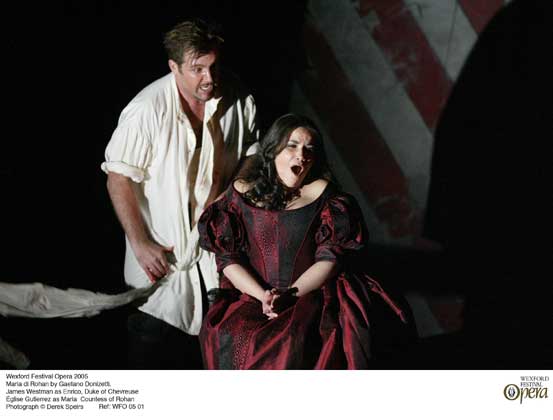
Chevreuse and Maria
|

|
A
somewhat El Greco like shot of Chalais and Chevreuse
|
|

Chevreuse
|

Armando
and De Fiesque
|
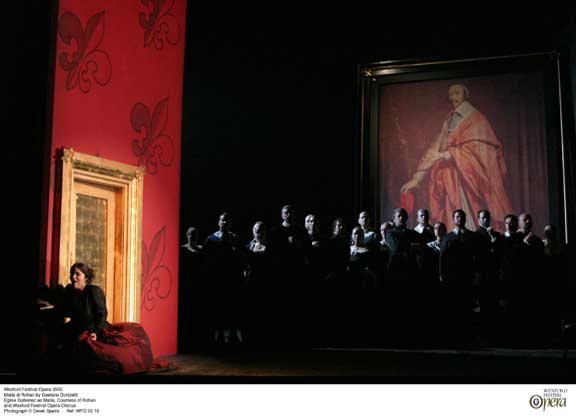
Maria
and the chorus
by Philip Gormley
Maria di Rohan
at the Wexford Festival (attended Sunday 23 and Wednesday 26 October, 2005)
2005 saw significant change at the Wexford Festival with the
arrival of the American conductor David Agler as Artistic Director – an arrival
overdue, in this writer’s view, after the uninspiring quality of the
performances seen under Luigi Ferrari both in Wexford and in Pesaro.
The proposal of Maria
di Rohan was a challenging artistic visiting-card for Maestro Agler. A typical economical
Cammarano libretto, even more fined down to suit a foreign audience, is
here set to a musical score which Donizetti gears to suit the tastes of a
Viennese public.
We admired the cultured elegance of the costumes designed by
Brigitte Reiffenstuel, perfectly in their historical period as the dramaturgy
of these pieces demands. In the depressing context of a stage nearly all in
black, we would have preferred to see greater variety in their colours, instead
of that unhelpful black or grey.
The stage design and direction tonight was entrusted to
Charles Edwards who was reluctant to stand back and let the music speak to us
with that eloquence so much in its gift. Time and time again he failed to
recognise the true plot core points, such as placing the action in the Court of
Louis XIII while inexplicably emphasising peripheral aspects, such as Richelieu,
who is here very much a background figure.
He had little sympathy for the ‘conventions’ of the Italian Opera of
this period. From redundant stage action
during the overture, through vocally and artistically damaging deployment of
the cast and chorus on stage, the ineptitude in staging the concerted finale,
and so on – we suffered it all.
The Crakow Philharmonic Orchestra was here conducted by
Roberto Polastri in two evenings of different artistic qualities. Sunday, 23
October, saw an unconvincing heavy-handed delivery of the score, sounding at
times Verdian in its intensity but matters improved on 26 October, although
greater directorial flair would have significantly improved matters. We would
have liked to hear the cast really tested by more invitations to soft gentle
singing, the better thereby to appreciate both the quality of the music and the
rigour of their techniques.
On that latter evening, notable for its splendid Italian pronunciation,
we could admire the elegant figura,
both on stage and vocally, of our Maria (Eglise Gutierrez) and appreciate the range
of vocal colours she has in her palette. Our Count of Chalais, Yeghishe
Manucharyan gave most impressive confirmation of that glorious concert
performance heard two days before. He has an instrument with a notable dark
colour, ever well deployed so as to put its many fine points on display. He
delivered his challengingly written part most convincingly, as did his rival in
love Enrico, here sung by James Westman. This role written for the ‘father of operatic
baritones’ Giorgio Ronconi, is not one to be envied; we admired the authority
in his fine instrument, mirrored in his impressive stage presence. The
interpretation of the (tenor) Armando of Gondi by Tyrone Landau was a joy to
hear both nights – it was ‘text-book’ singing in the most beautiful sense of
that term – a voice splendidly placed and a role also beautifully interpreted.
The outcome might thus be summarised in that classic school
report phrase, “Shows potential”, to which we
add “but needs serious professional commitment from all the production
team”. The creative flair of both Cammarano and Donizetti deserve no less, Mr
Agler.
|