|
Halévy's La
Juive
Production
by the Lithuanian National Opera, Vilnius, April 23, 2005
Photographs
by Mikhail Rashkovskiy
courtesy of the Lithuanian National Opera and Ballet
Despite the resurgence of
hitherto neglected operatic genres, such as baroque and bel canto, the core works of grand
opéra remain rooted to the margins, struggling to overcome the problems of
varying editions, the sheer size and quality of the resources needed, the
fatuousness, even by opera standards, of its plots and the often threadbare
characterisation and motivation.
Halévy’s La Juive (1835) has its share of all these but there are qualities
that shine through despite the unpromising format and it retained its place in
the repertoire up to the Second World War.
While the music is not outstandingly memorable, it is all well crafted,
melodic, inventively orchestrated and has several effective set pieces, of
which the best known is Eléazar’s “Rachel, quand du Seigneur”. However,
post war, it has had almost no productions, almost certainly on account of the terrible history
and the memories that the subject raises. Any treatment is bound to go beyond
mere operatic considerations and impinge on the political; even to wheel out a
traditional staging would be to make a statement.
Günter Krämer has risen to this
challenge, with not just one but two quite different productions in the space
of 5 years, the first, with Gottfried Pilz as designer, in Vienna in 1999,
revived both there and in New York and Tel Aviv and a second, which he designed
himself, in Vilnius and Warsaw in 2004.
The first production received wide attention and a fair amount of
criticism, particularly in New York.
There is a DVD (Orchester der Wiener Staatsoper, V.Sutej, DG 00440 073 4001). The second production, the main subject here,
has received rather less comment.
Krämer’s reasons for a second go
can only be guessed at but one might surmise that he wanted to get back to the
idea of “La Juive”, whereas the opera has tended to be seen primarily as a
tenor opera, partly from the change of emphasis in the ending from Rachel accepting
Christianity to her rejecting it and thus giving Eléazar his revenge and the
last word, but also historically from Nourrit’s active participation in its creation, Caruso’s
enthusiastic endorsement and, recently, Neil Shicoff’s championing of it. No doubt he also wanted to improve on some of
the less successful aspects of the first production. There Pilz’s design with a large ramp, rising from
near stage level on the left to quite a height on the right and taking up the
whole rear of the stage, meant that events on the stage proper were pushed to
the front or under the high end of the ramp and sometimes looked very cramped. Some
people were also confused by the somewhat complicated staging of the ending.
While the settings for both
productions were uncompromisingly modern, the Vienna
one was more stylised and symbolic in its approach, whereas Vilnius
was more straightforwardly realistic, within the confines of the setting. The processions and ballets, unnecessarily
added at great expense (some 150,000 francs with horses and tailor-made metal
armour) to satisfy its first Paris
audience, were omitted or reduced to a short walkabout and the opera slimmed
down to a much more intimate drama.
The plot, set in 15th
century Switzerland,
is a typical example of a Scribe libretto with actions driven forward by a
neatly fitting series of events, once judgement on their credibility is
suspended. Eléazar, a Jew, finds a baby,
Rachel, in the ruins of de Brogni’s
house in Rome after it had been
sacked. Some years later, Rachel,
brought up as Eléazar’s daughter, strikes up a relationship with Léopold, the
Emperor’s son, who has managed to fit it in between defeating the Hussites. He is disguised as a Jew and, unknown to her,
is not only already married but is a Christian and hence forbidden to have relations
with a Jew. She ends up denouncing him
to his family and de Brogni, now a Cardinal.
De Brogni pronounces the death sentence on the pair and on Eléazar. During his interrogation, Eléazar hints that de
Brogni’s daughter is still alive but despite de Brogni’s pleading will give him
no further information. Rachel eventually exonerates Léopold so that only she
and Eléazar are sent to their death and as she dies, in a vat of boiling oil, Eléazar
triumphantly tells de Brogni that he has just executed his own daughter.
However, this farrago contains
many powerful and moving confrontations and reflections and there is a depth to
some of the characters. In particular, Eléazar is a complex figure, not just a
victim of cruel intolerance but an unyielding fanatic in his own right. His offer to Rachel to save her own life by
converting to Christianity is hardly an honest one as he fails to give her the
full background of her birth. Halévy,
himself a Jew, was also happy to include the stereotype of Eléazar relishing
the money he gains from selling a chain to Eudoxie, Léopold’s wife.
The Vilnius
setting used a white backcloth and a raked translucent stage which was lit from
below for some scenes (see below for photographs) giving some stark and memorable images. A set of Venetian blinds, sometimes closed
and sometimes open enabling us to see scenes behind their bars, was used to
divide the front from the back of the stage and raised completely to give full
use of the whole stage when needed.
Costumes and props were largely monochrome except for the Cardinal’s red.
At the start, a group of Jews was shown
praying in front of the closed blinds, on which were written names of Holocaust
victims but looking from a distance like bricks in a wall. Their prayers were
interrupted by groups of thugs who beat them in a series of static snapshots
between which the theatre went completely dark.
These scenes were repeated about six times, perhaps once or twice too
many as the audience became a little restless as the point had been made.
The freer layout of the Vilnius
production made for better crowd scenes in Act 1 where they twice attempt to
punish Eléazar and Rachel, firstly for not observing a saint’s day and then for
sheltering in the cathedral porch. However, even at some 100 or more, the crowd
was too few for the size of stage to give a truly claustrophobic and oppressive
feeling. The Passover Seder scene also
benefited from its greater prominence centre stage.
Krämer included a nice line in gentle
humour as Léopold and his family awaited the arrival of the Cardinal and
Emperor, with Léopold trying to get some sleep on three chairs pushed together
while his bored children misbehaved, the boy tapping on the wine glasses along
with the music. This homely scene
rapidly turned savage, with the crowd looking on like some huge black vulture,
as Rachel denounces Léopold, a Christian, for seducing her, a Jew, overtly
sexually sitting astride him. The
Cardinal pronounces the death sentence on them and Eléazar. Their interrogation has them brought in
hooded and in chains, an all too familiar image for us today.
Scribe was very fond of some
spectacular final coup de théâtre and La
Juive, with Rachel being boiled alive was no exception. Donizetti, newly
arrived in Paris but with around 20 years of Italian theatre experience was amazed
by what he saw, “too much reality – the final scene too horrifying, the more
horrifying because of so much illusion” (H. Weinstock, Donizetti, London: Methuen & Co. Ltd, 1964, p. 108). Here,
Eléazar and Rachel were meticulously prepared for death being strapped into electric
chairs and the lights gantry lowered as the switch was thrown. There was a chilling horror about it but it
really needed a slicker coordination of lighting and actions. Krämer
also had de Brogni dragged away, no longer in command of events, as the law and
the mob took over, which rather alters the Scribe/Halévy view.
The performance under Martynas Staskus brought a more lyrical feel
to the music than had happened in the Vienna,
which had a far more edgy feel, driven by the sheer force of Shicoff as Eléazar.
Shicoff’s ghost took some time to shake
off, as one expected the French tenor Thomas Morris to attempt to emulate it whereas Krämer had
a much different Eléazar in mind, a petulant, fawning character flinging chairs
about in his frustration and impotence, his power residing only in his one
secret that he can only bring himself to exercise at the end. Morris, with
a rather nasal tone perhaps not that different from that of
the role's creator, Nourrit,
offered a convincing alternative reading, although
handicapped by not looking much older than his daughter.
The singing of chorus and
soloists was of a high level, even if the French was a bit woolly at times. Joana Gedmintaite was a moving and impetuous Rachel,
more proactive than in the Vienna
one, Regina
Silinskaite a haughty and patronizing Eudoxie brought near to collapse by the
turn of events and Edmundas Seilius did his best with the rather sketchy and unpromising
Léopold. Vladimiras Prudnikovas’s bass
was occasionally unsteady and the switch from de Brogni’s early sympathetic
stance to his later unreasoning persecutor was not altogether successful,
perhaps, ultimately Scribe’s fault for attempting to weld together such
disparate traits.
All round an excellent
production, rather broader in its sympathies than Krämer’s Vienna
effort, which was so comprehensively dominated by possibly an over fervent
Shicoff. Unfortunately no recording it likely to be
made of this production but, despite Max Loppert’s dismissal in May Opera magazine, the DVD of the Vienna
performance is worth consideration by anyone interested in this era or in how
such an unwieldy beast as grand opéra
can be made a moving dramatic experience today.
Both Krämer’s efforts have been honest and thoughtful attempts to do
this but the price has been the removal of many of the elements that made it grand opéra in the first place, except
for its engagement with the political.

Eleazar (Viktor Aleskov) and Rachel
(Joana Gedmintaitel) threatened by the mob

Eleazar (Viktor Aleskov) and Rachel (Joana Gedmintaite)
at the Passover Seder. The names of Holocaust victims
can be seen on the wall behind.

Rachel
(Joana Gedmintaite) denounces Leopold (Edmundas
Seilius) with Eleazar (Viktor Aleskov), de Brogni (Vladimiras Prudnikovas), Ruggiero
(Arunas Malikenas) and Eudoxie (Regina Silinskaite)

Eudoxie (Regina Silinskaite) with Leopold
prostrate before de Brogni (Vladimiras Prudnikovas)

Eleazar (Thomas Morris) and Rachel (Joana Gedmintaite)
meet their deaths
|
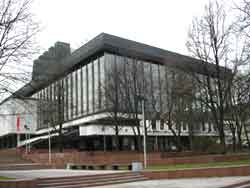
The Lithuanian National Opera and
Ballet theatre is a rather austere and cavernous, Soviet era, building, but with excellent sight
lines and acoustics (apparently some audio enhancement) from
the balcony seats. A well produced
and informative program in Lithuanian and English as well as a libretto was
available. It is a venue well worth
trying, if you feel like a visit to Vilnius,
a very pleasant and relaxed city.
|
|
|