



Donizetti's Lucia di LammermoorOpera Holland Park, London, July-August, 2025 Alan Jackson,
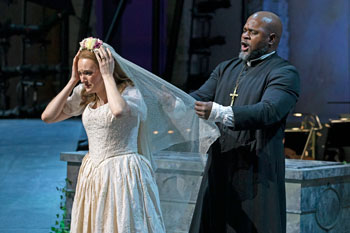
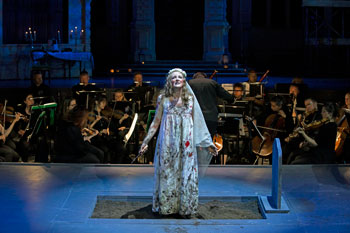
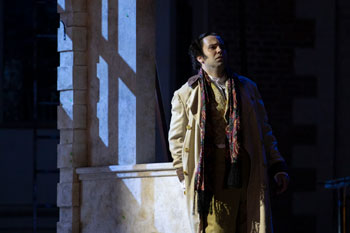
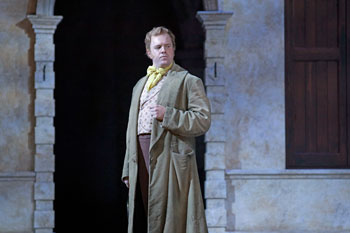
July 26, 2025 A warm welcome to Holland Park’s new production of Donizetti’s masterpiece. It was more than decently sung, extremely well played by the City of London Sinfonia and, though there were some directorial quirks, it avoided the excesses of the current Covent Garden production. The Lucia, Jennifer France, possesses a light voice, so I missed the intensity that Callas or Sutherland could bring to individual phrases, but most of the coloratura was in place – downward scales better than upward ones – and all the high notes were secure. Her verse of "Verranno a te" was spun on a beautiful pianissimo which would have been superb in a closed theatre; here with some extraneous noise from the park outside it was a bit mis-judged. She presented a convincingly wilful character until broken by her controlling brother and tutor. Her lover, Edgardo, was sung by José de Eça, to my mind the stand-out performance of the evening. He possesses a burnished timbre throughout his range, passionate and forceful, yet sensitive in a lovely rendering of his final aria. His bel-canto manners were matched by Blaise Malaba as Raimondo, his aria when convincing Lucia to marry Arturo and the arioso preceding the Mad Scene were both marked by excellent legato. Morgan Pearse’s voice is a shade too gravelly for my taste but he caught Enrico’s desperation well especially in the duet with Lucia. The smaller parts were all well-taken: Arturo by Joseph Buckmaster, Alisa by Charlotte Badham, Normanno by David Webb. The Opera Holland Park Chorus, chorus master Dominic Ellis-Peckham) contributed both lustily and sensitively. ©Ali Wright
The conductor was Michael Papadopoulos who kept a suitably tight rein on proceedings. I thought some of the slow passages were too slow, above all the Fountain Aria, which I long to hear sung much faster than we usually hear – it is a narration after all, and so would benefit from being taken at a conversational pace. The rest was fine, the famous sextet loudly and deservedly applauded. Though some cabaletta repeats were missing (in the case of Raimondo’s the first verse was cut leaving in the second with its perticchini for Lucia) we did hear some passages traditionally cut: the coda to "Quando rapito", the chromatic scales for Lucia in her duet with Enrico, the Wolf’s Crag scene and most importantly the tempo di mezzo in the Mad Scene. Full marks and thanks for that. The traditional (i.e. neither by Donizetti nor in his style) cadenza with flute obbligato was used. ©Ali Wright
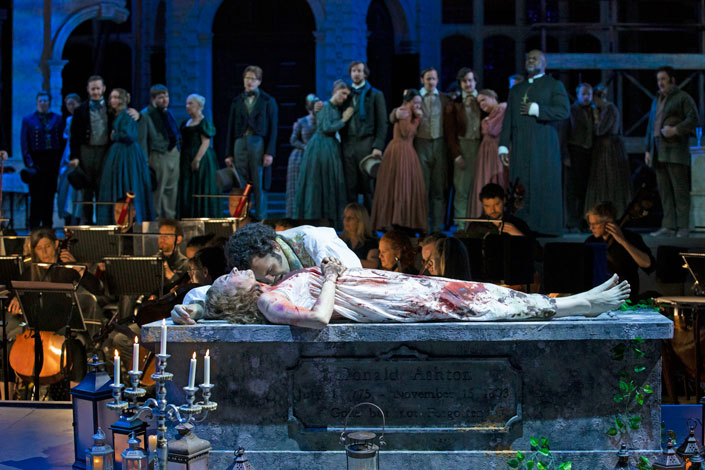
The Holland Park stage is split into two parts. The rear housed the interior scenes. The forestage was used for the outdoor ones. The orchestra is seated between them and side ramps connect the two halves. The actual sets were pretty minimal (fine by me) and props suggested the locations. Two tomb-like structures served for the Ravenswood cemetery of the last scene, with the grave of Lucia’s mother (an Ashton after all) incongruously between them. Costumes suggested to me the period when the opera was composed rather than the late seventeenth century of Scott’s novel. Designs were by Neil Irish, the choreographer was William Byram, lighting by Tim van ‘t Hof The Director was Cecila Stinton who got the cast to act convincingly and much was as prescribed by the score. However, there were the quirks and no doubt these accretions to Cammarano’s libretto were down to her. They didn’t seem to bother the audience whose appreciation was shown throughout and at the end. Aptly enough, we see Lucia during the opening Prelude as she lays flowers on a newly dug grave – that of her mother. (Later the flowers unconvincingly become her wedding bouquet.) Less happily, the introduction to the Fountain Aria has Lucia seeing the ghost of the young Ravenswood girl, but here the action runs counter to the music. That harp solo is so evocative of the fountain, yet there was no sign of any fountain. The ghost wanders in and out of the action, sometimes slowly walking, sometimes it crouches immobile. I was unable to discern any particular intention behind these appearances other than as a general expression of Lucia’s unstable mind. During the Wolf’s Crag duet we also saw Arturo attempting to consummate his marriage to Lucia, at which point my heart sank with recollection of the Katie Mitchell Covent Garden production. Mercifully here the two superfluous characters quickly escaped offstage, I think consummation incomplete, and we could concentrate again on the two enemies. There was a novel twist at the opera’s end. After the first verse of Edgardo’s final cabaletta Raimondo carried the dead Lucia down to the forestage and laid her on one of the tombs – was I the only one to find it strange that an Ashton was brought to the Ravenswood burial site? Still, it meant that Edgardo could stab himself and drag himself to expire on top of Lucia’s corpse. Very Romeo and Juliet. If it doesn’t bear too much analysis, it did provide a moving end to the opera.
Edgardo and Lucia ©Ali Wright |