“THAT
ROSSINI COMPANY”
DOES LE COMTE ORY
Alberquerque, New Mexico,
February 5, 10 &12, 2023
Charles Jernigan,
February 2023
(Charles saw the February 10
performance)
Photos by Lance W. Ozier
One would not expect to find a sophisticated
opera company in the windswept mesas of central
New Mexico, but the Land of Enchantment (New
Mexico’s official nickname) boasts two. The more
famous, Santa Fe Opera, performs a summer season
outdoors in a beautiful setting just north of
the capital, but feisty Opera Southwest is
celebrating its fiftieth anniversary in the
state’s largest city, Albuquerque. Under its
Music Director, Anthony Barrese, the company has
carved out a special niche by unearthing
forgotten nineteenth century works like Franco
Faccio’s Amleto and Giovanni
Bottesini’s Ali Baba, as well as
premiering new works with a southwest flavor
like this year’s Zorro by Hector Armienta. And
then there is Rossini. Opera Southwest has
performed more Rossini operas than any other
American opera company—eleven to be precise, and
counting. That is not to say that Puccini and
Verdi and Wagner are ignored, not at all, but
Rossini is Maestro Barrese’s first love, and
Albuquerque audiences have had the good fortune
of seeing more Rossini in recent years than any
other city in America. Call them Pesaro West
(after the festival which takes place annually
in the composer’s hometown). Or as The Santa
Fe New Mexican nominated them recently, "That
Rossini Company".
This year’s Rossini offering was one of the
composer’s best works, Le Comte Ory, an
opera full of irony and wit and bawdy humor
allied with the most sophisticated and tuneful
music that sends you home humming the tunes. Le
Comte Ory came as something of a surprise when
Rossini premiered it 1828 at the Paris Opera. A
comic opera which mocks religious hypocrites and
has Ory and his men dressing up as nuns to
infiltrate a castle filled with horny young
women would never have made it past the
conservative forces running the Opèra if the
composer had not been Rossini. As for the
composer, he had found an ideal vehicle to
recycle music from his Italian opera Il
viaggio a Reims, an occasional work written
for the coronation of the French king, Charles
X, which Rossini did not believe would have a
shelf life beyond the new king’s assumption of
power. There was new music in Ory too, including
the most perfect trio Rossini ever wrote—a sort
of nocturne-parody which encapsulates all the
wit and humor of the situation with suave and
luscious melodies: a man dressed as a woman (Ory)
is trying to make love to a woman (Countess
Adele), but in the dark is really making love to
a man (his page, Isolier), a role sung by a
woman dressed as a man. Rossini himself no doubt
relished the inherent parody of the operatic
traditions of his time when it was common to
have mezzo-sopranos sing male roles, but he
anticipates the complexities of our time when
gender roles are not always so fixed and gender
bending is a common—and sometimes
controversial—occurrence.
For this production, Maestro Barrese used the
critical edition of the score by Damien Colas
published in 2014 which includes some music not
in the traditional (Troupenas) edition used by
most opera companies for the last 200 years
(e.g., the Metropolitan in their 2011 production
or in the Chicago Lyric Opera production of
October, 2022). There are many small
differences, but the most notable one occurs in
the opera’s finale, now extended by some 60
measures. In the traditional reading, the opera
seemed to end too abruptly when the crusaders
return home, putting an end to Ory’s attempts to
storm the castle of Countess Adele and her
ladies. Now, with the new music, along with
accurate articulation envisioned by Rossini and
the restoration of smaller cuts in several
numbers (e.g. the Gouverneur’s aria), the opera
has new life. Barrese also encouraged his
singers to choose variations and ornaments which
fit their own voices, based on the very
extensive possibilities by Rossini and others
published in the critical edition. Rossini would
certainly have approved. Apparently, this is the
first time that the complete opera based on this
critical edition has been done in North America.
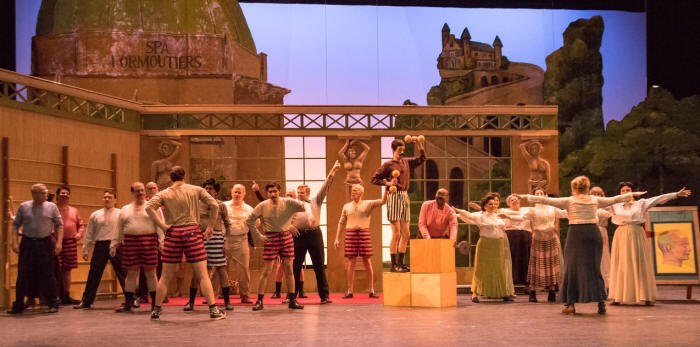
The ’spa’ at Formoutiers with Adele’s castle on
the hill
The comedy of Le Comte Ory comes from
the incongruous juxtaposition of religion and
sex, a technique harking back to the fabliaux of
the Christian Middle Ages, most famously found
in Boccaccio’s Decameron (1348); that
is a time period also associated with the
semi-legendary figure of Count Ory and
the fabliau-like tale of his use of religion to
lay siege to the chastity of the Countess Adele
and her ladies. The story first appeared in
literature in an allegorical fairy tale by
Marie-Jeanne L’Héritier de Villandon called “The
Discreet Princess, or the Adventures of Finetta,”
published in 1696. (L’Héritier was the niece of
Charles Perrault, whose fairy tale collections
include familiar versions of Cinderella,
Bluebeard, Little Red Riding Hood and Sleeping
Beauty among many others.)
What was a moral tale warning of sexual
dalliance in L’Héritier became a comic, bawdy
tale in versions in the eighteenth and
nineteenth centuries. Eugène Scribe and Gaspard
Delestre-Poirson turned it into a one act play
with music (a vaudeville) in 1816, and
twelve years later Scribe turned it into a
libretto for Rossini’s opera. In Act 1, Ory
disguises himself as a “holy hermit” come to
‘comfort’ the distressed ladies of Formoutiers,
whose menfolk are all off at the crusades. When
that doesn’t work, Ory and his men all dress as
nuns on a pilgrimage to infiltrate the castle in
Act 2. Thus phony “holy” figures use religion to
further the satisfaction of their sexual
desires, a phenomenon as familiar today as it
was in the fourteenth century of Boccaccio.
Opera Southwest’s production, by Kristen
Barrett, brought the action forward from the
Middle Ages to the art nouveau period at the
beginning of the twentieth century. In Act 1,
instead of disguising himself as a hermit, Ory
plays the role of a health guru in the manner of
John Harvey Kellogg, the inventor of corn
flakes, who ran a Sanitarium/hospital at Battle
Creek, Michigan, in the early twentieth century.
(The 1993 novel The Road to Wellville by
T. Coraghessan Boyle and the subsequent
comedy-drama film may have been the inspiration
of the production.) Formoutiers has become a
health spa, perhaps suggested by the spa town of
Plombières-les-Bains, the setting for Il
viaggio a Reims, the musical sire of
Le Comte Ory.
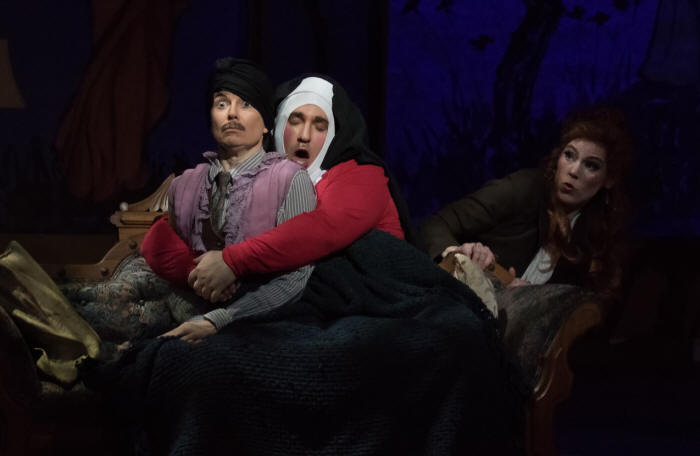
“A la faveur de cette
nuit obscure”: Sister Collette makes love to
Isolier.
In this version Ory uses an ‘exercise’ regimen
to exorcise the depression and ennui among the
women while suggesting that a love affair (sex)
is just the thing to restore health.. Act 2
drops the health fad context and restores the
libretto’s original joke when Ory and his men
dress as nuns to gain access to the Countess’
castle, although this castle (sets by Dahl Delu)
is decorated with paintings of lovely art
nouveau damsels. Barrett directed her singers
carefully and individually, and movement and
stage action were consistently funny. The
chorus (the men dressed in early twentieth
century exercise attire while the women were
dressed as lovely Gibson Girls) acted
individually too. It was altogether the
funniest Comte Ory I have ever seen, with clear
motivation and action. The only slightly jarring
note in the updating came with anachronistic
references to crusaders returning from the wars,
while the only scene where the stage action
could have used some work was the sexually
ambiguous trio, which took place on a Victorian
settee in the Countess’ sitting room and
sometimes kept the characters at some distance
from each other. Most productions set this scene
in the Countess’ bedroom and the trio plays out
on and around a bed.
The production was fun, the scenery
was clever and amusing (with a castle on a
distant hill in Act 1) and the lighting (by
Brittany Chato) kept the focus on the
principals. Best of all was the singing by
several artists who have become favorites in
Albuquerque. Christopher Bozeka (Nadir in Opera
Southwest’s Ali Baba) led the list as the
titular character. He has a perfect “Rossini”
tenor voice, capable of sweet and dulcet tones,
including high head notes, accompanied by an
easy facility with coloratura and some
spectacular full-voiced high notes. He is an
excellent actor too. Bozeka will sing the
fiendishly difficult role of Rodrigo in
Rossini’s Otello in Central City next summer.
Tim Mix as the Tutor/Governor had the deep, low
notes to match Bozeka’s forays into the
stratosphere. Mix is a young, tall and imposing
presence, and for his aria (“Veiller sans cesse”),
he dropped to notes which would make Sarastro
envious. Matthew Hanscom sang Raimbaud, Ory’s
henchman, with great gusto, mastering the quick parlando of
his drinking song “Ah, la bonne folie.”
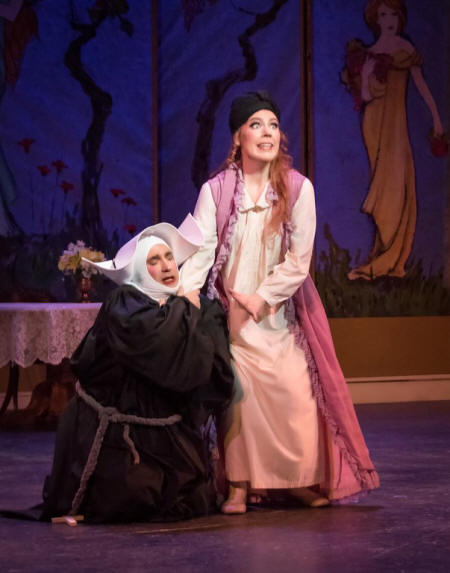
Christopher Bozeka
and Lindsay Ohse
The
women were equally good. Lindsay Ohse is a
favorite in Albuquerque, where she has
previously sung Norma, Amenaide (Tancredi) and
Serpina (La serve padrona). Her silvery high
notes and beautiful, rounded tones are matched
by her ability to plunge into the depths, and
she has a real gift for comedy. Her Adele was
less ditzy blonde than frustrated woman who
nurses an affection for Ory’s page Isolier, but
whatever she was doing, she had a flawless way
around the difficult coloratura of the
role. Amanda Crider was also perfect in the
comedy surrounding Isolier, with a funny
mustache drawn on her lip. Isolier’s Act 1 aria,
“Une dame de haut parage” is, however, no joke
coloratura-wise, and Crider brought it off with
great panache. I loved the way the production
played with her petite frame, as the taller
Adele picks her up and swinging her around in
the finale. But Crider’s voice belied the
diminutive size of her person; it is big and
rich. Laurel Semerdjian added her rich mezzo
voice too, as Ragonde, Adele’s lady-in-waiting,
or companion in this production. Mary Brzezinski
sang Alice. All in all, this was the best of
the operas I have seen in Albuquerque; every
role was excitingly sung, the acting was
continuously funny with well-nigh perfect comic
timing and the stage direction was the best I
have seen in this opera (a history which starts
for me in the early 1970s at the University of
Southern California when I first fell in love
with this Rossini work).
Of course none of it would
have been possible without the musical direction
of Maestro Barrese, who combines the talents of
conductor, impresario and musicologist. The
Opera Southwest Orchestra now has eleven Rossini
operas under their collective belt—they are
familiar with the style. Barrese knows how to
build a climax in the irresistible Rossini
manner that makes you want to jump out of your
seat, and he knows how to trust the singers and
give them the space to embellish so that each
performance is a little bit different vocally.
His use of the critical edition’s extended
finale gave us time to see that Adele and
Isolier are united—and that Ory is plotting his
next futile assault on female virtue. Why on
earth other companies, including the Met and
even the Rossini Opera Festival in Pesaro would
not use this version I do not know—but Barrese
did use it. Just another reason why Opera
Southwest is “That Rossini Company.”

The Nuns
find the wine cellar; Matthew Hanscom as
Raimbaud
P.S. After the February 10, Friday
night, performance which I saw, the pandemic
struck, and by Saturday morning both Adele and Ragonde had succumbed to Covid-19 if not to
Ory’s blandishments. In a frenetic twenty-four
hour period Teresa Castillo and Kathryn DeYoung
flew in, learned their roles and sang Adele and
Ragonde, and saved the Sunday matinee from
cancelation. By all accounts they were very well
received.
|