



Donizetti's Lucrezia BorgiaEnglish Touring Opera, Hackney Empire, London (then on tour) Alan Jackson,
March 3, 2023 With this production by ETO Lucrezia Borgia returned to the London stage for a single performance, prior to touring to Poole, Sheffield, Norwich, York, Durham, Chester, Cambridge, Snape, Cheltenham, Buxton, Leamington Spa and Exeter. It was last seen in London in 2011 at ENO (with Claire Rutter and Michael Fabiano). Prior to that Covent Garden mounted it for Joan Sutherland in 1980. And there have been concert performances in 2003 (Chelsea Opera Group with Nelly Miricioiu) and 1968 (London Opera Society with Montserrat Caballé). Outside London, it was seen at the Buxton Festival in 2009 (Mary Plazas). So firstly, let me welcome this new production of a fine piece, one that deserves to be played more often. The opera was performed in an edition that aimed to reproduce Donizetti’s wishes for its 1833 premiere at La Scala. The most striking of these is that he wanted to end the opera with the death of Gennaro, though in the end his prima donna, Henriette Méric-Lalande, demanded and got a final showy cabaletta to round off the evening. ETO went back to the idea of ending with Gennaro’s death but inserted the very beautiful arioso written for La Scala in 1840 and completely omitting the cabaletta for Lucrezia. Neither did we hear any of the other post-1833 additions: a cabaletta to Lucrezia’s Act 1[1] aria (available on Caballé’s recording) and two possible arias for Gennaro to open Act 3 written for Mario and Ivanov which can be heard sung by, respectively, Juan Diego Florez on his recital CD entitled “Belcanto Spectacular” and Giacomo Aragall on the Sutherland/Bonynge complete set.
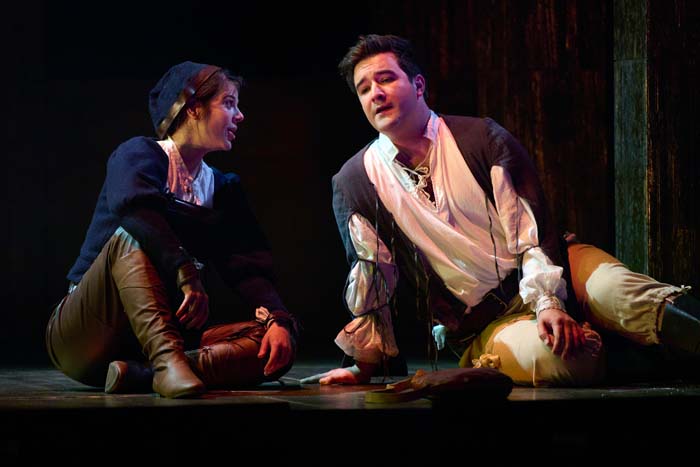
Katie Coventry (Orsini); Thomas Elwin (Gennaro) Another point of interest was the use of The Old Street Band, which is ETO’s period orchestra, here playing on instruments of the early 19th century. This produced a lovely mellow sound for the start of the opera. Some later loud and high woodwind phrases sounded momentarily a bit shrill, but I was convinced by the programme’s assertion that we were hearing something closer than usual to the sound Donizetti would have heard. At first I thought they were also playing at slightly lower pitch than usual, but I could be mistaken here, and anyway the ear adjusts very quickly. I wish I could report that the vocally all was well, but alas there was a weakness at the centre. In 2018 Paula Sides saved the day by stepping into a Chelsea Opera Group concert of Massenet’s Thaïs at the last moment, singing that title role with confidence and a creamy voice that immediately commanded attention. Unfortunately, little of that was apparent here; her voice lacked power and colour especially in the middle register and the overall effect was pallid. Donizetti’s fioriture in her two arias was rather skated over though she did produce an admirable trill with which to end the first. But surely Lucrezia has to sound imposing, and Sides didn’t. I didn’t find any dramatic qualities to compensate.
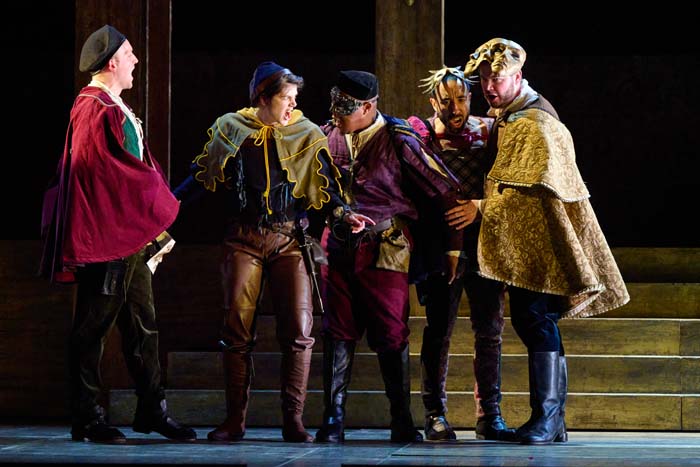
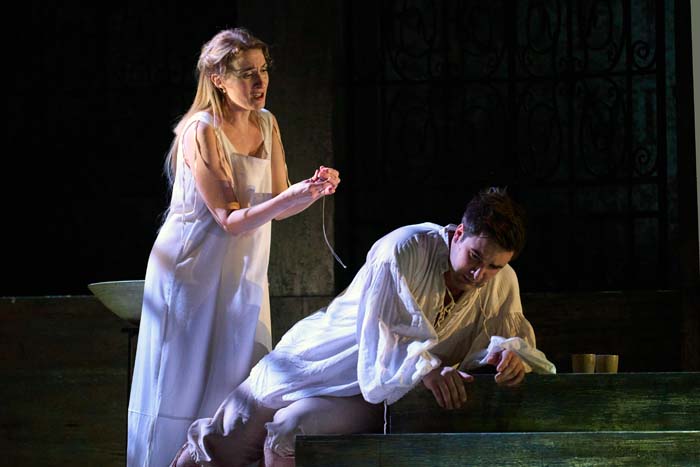
Orsini and friends The Gennaro of Thomas Elwin was better, with unstrained tone and some nice lyrical phrasing. His death scene was affecting and effective. But his stage presence is rather wooden and his costuming didn’t help the projection of a handsome young man. Alfonso was played by Aidan Edwards, the voice admirably free in its upper register, a little underpowered at the bottom – indeed his programme biography lists a number baritone roles, but this is a bass part. Katie Coventry has the figure to be a convincing Orsini (a trouser role) but not quite the power to stand out in her/his group of friends. She didn’t interpolate any cadenzas into her brindisi in the manner of Ernestine Schumann-Heink, Sigrid Onegin or, in more recent times, Marilyn Horne.
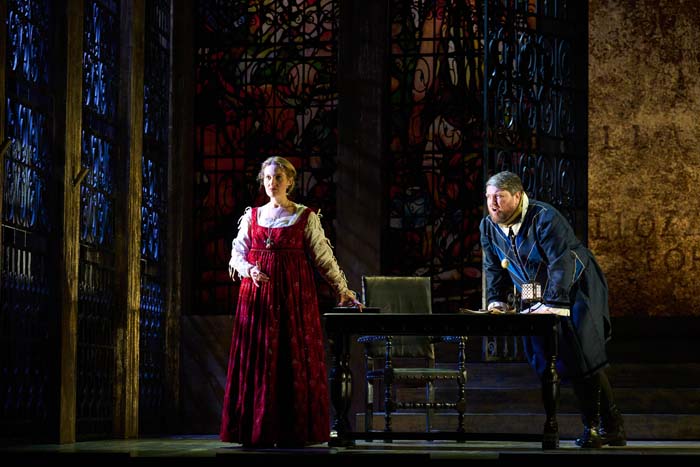
Paula Sides (Lucrezia) Smaller parts were rather variably taken and there was a chorus of solo voices, no doubt because of budgetary considerations. This young cast will surely develop more stage craft as the run of performances, and their careers, continue. At present there was a lack of naturalness and the brawl in Act 3 was unconvincing and too protracted. The Director was Eloise Lally, who together with the Designer Adam Wiltshire, at least gave us a traditional production. Sets were basic as one would expect - ETO doesn’t have funds to spare – but perfectly adequate and containing sufficient details to suggest early 16th century Venice and Ferrara. The only novelty was setting the final scene in a bath house with Gennaro and friends all in cream-coloured smocks. However, no regieteater “concept” or extraneous business were in evidence – hooray! The conductor was Gerry Cornelius who set satisfying tempi and obtained lively playing from his orchestra. Only occasionally were the singers drowned. Appoggiaturas were properly in place.
Paula Sides (Lucrezia); Aidan Edwards (Alfonso) My own preference would still be to allow Lucrezia her final cabaletta. The first half of each verse is universally thought to be among Donizetti’s finest – it is one of his wide-ranging Moderato movements. I own to liking the second halves too. Showy, yes. But in the throat of a great singer I fine those roulades dramatically effective and in character. It was very good to hear, once, the opera end with Gennaro’s death. It was very moving and many people will prefer it. However, the opera is called Lucrezia Borgia and not Gennaro! So, a genuine welcome despite the reservations remarked on above. ETO productions of Donizetti always have an integrity sometimes missing from more starry performances. Previous Donizetti choices have included rarities: Pia de’Tolomei (2016), Il furioso all’isola di San Domingo (2015), L’assedio di Calais (2013 and 2015, both times with Paula Sides), Anna Bolena (2008). And not so rare: Don Pasquale (2009 and 2010). ETO has a good record with Donizetti operas and I just hope it doesn’t wait another 7 years before it revives another, perhaps Fausta, Maria di Rohan or Parisina though there are plenty of others!
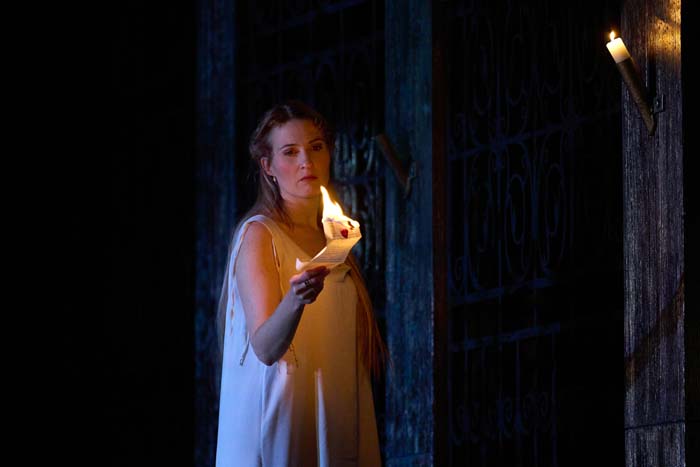
Paula Sides (Lucrezia); Thomas Elwin (Gennaro)
[1] ETO described the opera as being in Three Acts rather than a Prologue and Two Acts. |