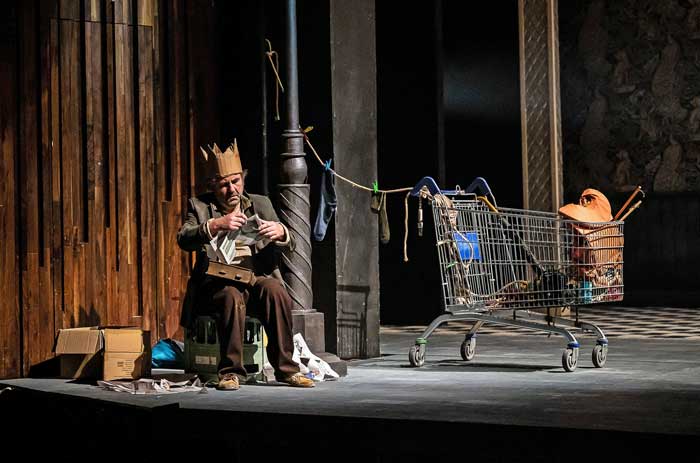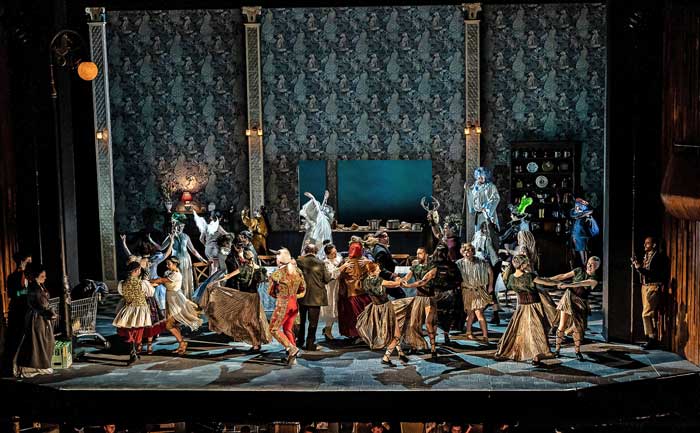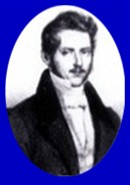




David's Lalla-RoukhWexford Festival, October/November 2022 Charles Jernigan, November 2022 Photographs by Clive Barda, courtesy of Wexford Festival. If La tempesta failed to convince, David’s Lalla-Roukh brought honor back to Wexford’s 71st Festival. It is hard to understand why this work, so full of continuous and memorable melody, is not part of the standard repertory, and yet Wexford’s production was only the second revival in modern times and the first in Europe. The first revival was by the American company, Opera Lafayette, which performed Lalla-Roukh in Washington and New York in 2013 (review here); a subsequent CD recording of that performance cut all of the spoken dialogue which had been performed ably by the Francophone cast in New York. If the title sounds vaguely familiar, it is because it is the name of a work by the Irish poet and writer Thomas Moore, a work once so popular that there was actually a middle-aged woman at the opera performance in New York whose name was Lalla Rookh. She said it had been a tradition in her family to name a female child after the Moore heroine for many, many years. In the Moore tale, Lalla Rookh (using Moore’s spelling) is a Moghul (Moslem) Indian princess who has been betrothed to the King of Burkhara, whom she has never seen. On the long journey from Delhi to Samarkand in Bukhara (in today's Uzbekistan) the Princess encounters a minstrel who keeps serenading her with narrative songs. Lalla Rookh, of course, falls in love with the penniless minstrel, who of course turns out to be the King in disguise--because he wanted to test his betrothed and make her love him for himself and not for his position. In Moore's work, the story of Lalla Rookh is a frame tale in prose; the four narrative poems that the minstrel sings to her are separate stories which make up most of the work. David's librettists, Michel Carré and Hippolyte Lucas, took the frame tale as the basis for their story and discarded the rest. Félicien David (1810-76) is an interesting composer. Early in his life he was an ardent participant in the Saint-Simonian movement, a group of utopian socialists who believed in world peace fostered by greater communication and trade, and who preached the coming of a female messiah. Naturally, they believed in rights for women that were far ahead of their time. They also believed that music held a central place in promoting harmony, understanding and peace, and musicians were highly honored by them. One of their projects promoted building a canal at the isthmus of Suez because they felt that the increased trade would produce mutual understanding. Again, they were decades ahead of their time. David wrote hymns for the group and choral pieces, until the Saint-Simonian movement was eventually banned by the French government which did not like their socialist tendencies. David traveled with other adherents of the cause to Turkey and Egypt on a long trip and was much influenced by what he heard there. Because of his trip and his interest in the region David became one of the first 'orientalist' composers and led the movement of music and opera in particular that used 'oriental' subjects. "Oriental" in those days meant everything from North Africa across what we call the Middle East through India to China and Japan. From the time of Lalla-Roukh (1862) to at least Puccini's Madama Butterfly (1904/Japan) and Turandot (1926/China) opera composers exploited the "orient" and satisfied a burgeoning western interest in ‘exotic’ lands. Some of the more famous works that used these locales and offered vaguely "oriental" sounding music were Les pêcheurs des perles (Bizet, 1863/Sri Lanka), Lakmé (Delibes, 1883/India), La reine de Saba (Gounod, 1862/ancient Ethiopia and Yemen) and even Aida (1871/Egypt). David first became well known to the general public with his programmatic symphonic ode Le désert (1844), a sort of secular oratorio with spoken narration which depicted several aspects of a camel caravan moving across the Egyptian desert, including a sand storm, a stop at an oasis and the muezzin's call to prayer in the morning. In Le désert, David used what he called "airs arabes", native melodies he transcribed while in Egypt. In his career David used many exotic locales, and not only in the "orient": there was Brazil for his opera La perle du Brésil and the Caribbean for an oratorio about Columbus. He also attempted a big grand opera called Herculaneum which was performed in Wexford in 2016 review here). Lalla-Roukh balances the love plot with a comic set of characters, the ambassador assigned to bring the princess to Samarkand, Baskir (a bass) and the Princess' lady-in-waiting Mirza. The music is luscious and tuneful and cleverly orchestrated. The "oriental" atmosphere is achieved with the use of certain instruments and harmonies and does not use authentic Indian or Persian melodies. It is hard to understand why an opera which was once so popular faded so quickly and completely from the scene after 1900 when it had been heard hundreds of times in a dozen different languages and countries in the last 40 years of the nineteenth century. Lalla Roukh was also very influential as practically the first of the "oriental" operas. You can hear bits and pieces of it in Berlioz' Les Troyens (Berlioz was full of praise for the work), in both Les pêcheurs des perles and Carmen, and in Lakmé. If David's work has survived at all, it is through the work of other, better known composers. Wexford’s production, like the Opera Lafayette production of a decade ago, took account of the loudly-voiced critique that "oriental" operas are artifacts of Colonialism and should be banished (even Madama Butterfly!). In America the directors had brought in an Indian dance troupe which performed authentic Kuchipudi style dances and they invited India’s ambassador to the U.S., who came to the performance we saw in New York. In Wexford, Stage Director Orpha Phelan noted the current critique of European Orientalist works and created a frame which solved two problems at once by distancing the audience from Thomas Moore’s 1817 tale while finding a way to handle the spoken dialogue which is a feature of opéra comique, all the while assuring an "Irish" take on the story. The initial stage set depicted "Leila O’Rourk’s Tea Emporium", a cafe which one might find on any Wexford corner. During the charming overture, a homeless man entered pushing a grocery store cart and looking in a trash bin for discards. Among his found 'treasures' was a thick tome of Moore’s poetry. As he starts to read, the tea shop set lifts and a gaggle of characters reminiscent of a Fellini movie enters and transforms the set into a wild fantasy world for the story to come. We are off to "magic" in a surprising way.
WFO © CLIVE-BARDA/ArenaPAL The Homeless Man / Narrator The homeless man then took on the role of narrator who told the story and linked the musical numbers in English, using a specially prepared text in rhymed couplets by Timothy Knapman; the disheveled man becomes an Irish storyteller (with a thick brogue, at least for American ears) who lards his spoken text with bawdy jokes and local Irish references. With its "Irish" frame, the story becomes a tale told by an Irishman of a time and place long ago and far away, which is what it was for Thomas Moore too. It is worth noting that Lalla Rookh is a Persian-style tale with an Indian heroine written by an Irish poet, set to music by a French composer to a French text and performed for an international audience in a small Irish seaside town. There is no reason to fear that it smacks of cultural appropriation or condescension; David wanted to use music to promote cultural understanding.
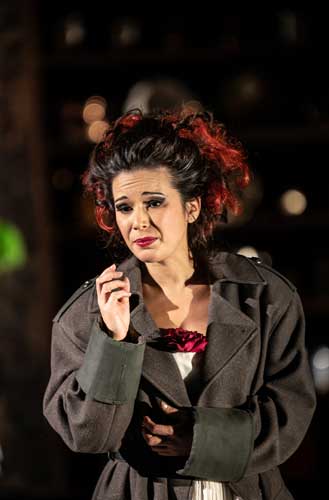
WFO © CLIVE-BARDA/ArenaPAL Act 1 - Cast with dancers The music offers each principal an aria in each act. Both of Lalla Roukh's are astonishingly varied and beautiful--"Sous le feuillage sombre" and "O nuit d'amour". Noureddin, the minstrel-king, sings a romance in typical couplet form in Act I ("Ma maitresse a quitté la tente") to entertain the Princess, and in Act II he sings a barcarolle ("O, ma maitresse") off stage, an utterly charming piece which surely was inspired by Ernesto’s serenade in Donizetti’s Don Pasquale. There are duets in both acts, and one of them, a comic duet between Baskir and Noureddin in which the former laughs about how he will dupe the King not knowing that he is confessing to the King in disguise, might remind us of the smuggler's quintet in Carmen (1875), but would have reminded Carmen's early listeners of Lalla Roukh. The love duet in Act II ends with a section which reminds Ralph Locke, a musicologist who has written about David, of Edgardo’s "Tu Che a Dio spiegasti l’ali" in Lucia di Lammermoor. In David’s hands, all of these numbers are singularly beautiful and evocative.
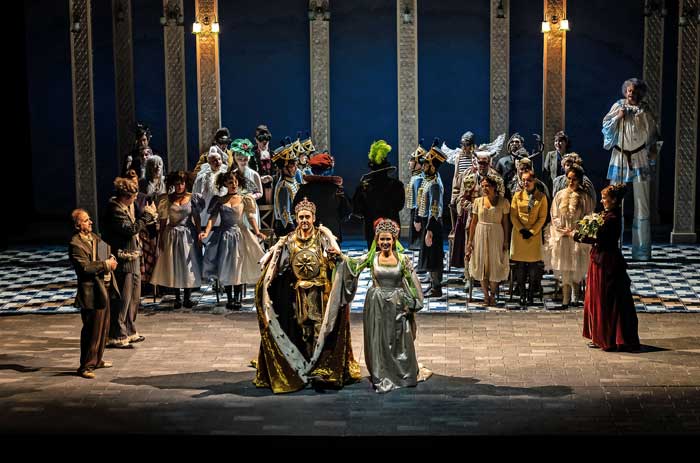
Essentially it is a fairy tale with a happy ending and as long as the fairy tale is taken seriously (as it was in Wexford), it is hard to see how it could fail to enchant.
WFO © CLIVE-BARDA/ArenaPAL The Happy Finale |