



Mercadante's Il proscrittoBarbican Centre, London. June 28, 2022 Alan Jackson,
July 2022 When Opera Rara gave its concert performance of Donizetti’s Les Martyrs just after their recording sessions in 2014 there was a moment when the whole thing caught fire. The first half had been impressive, with the grandeur, solemnity and seriousness of Donizetti’s score well captured. Then just after the interval, Michael Spyres began his cabaletta “Oui, j’irai dans leurs temple” and somehow the audience became more involved. When he capped the cabaletta with a high E the atmosphere was electric and we listeners erupted. Something similar happened at the Barbican. The first act of Il proscritto contains a beautiful cavatina for the second tenor, a lovely duet for mezzo soprano and contralto and an imposing concertato, all splendidly performed. Then, just after we returned from the interval, there is a duet for the two tenors and the sparks of electricity really began to fly. Not that there were any stratospheric high notes (in fact neither tenor part is particularly high-lying) but their confrontation grabbed us viscerally, the audience exploded and the applause went on and on. Then just as with Les Martyrs, this new intensity was maintained till the end of the evening. Increased even, when the contralto stunned us in her aria with its wide-ranging and extremely rapid coloratura.
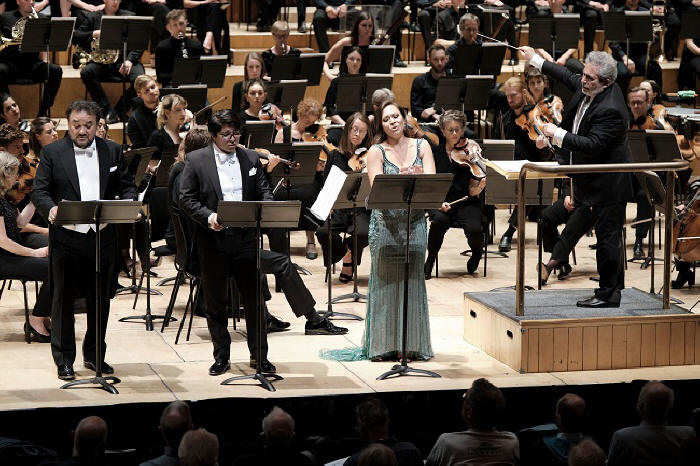
photo - Russell Duncan The plot of Il proscritto, set in 17th century Scotland with its Royalist/Cromwellian tensions, revolves around its heroine Malvina. Her first husband Giorgio, a Royalist, has long been believed dead in a shipwreck. Her family want her to marry Arturo, a Cromwellian, and Malvina has grown to love Arturo despite feeling guilty when she thinks of her first husband. Of course, as this a romantic melodrama, Giorgio is still alive and of course he turns up on Malvina and Arturo’s wedding day. The two tenors veer between antagonistic rivalry and understanding of Malvina’s plight; she solves the choice dilemma by taking poison at the opera’s end. The fourth principal is Odoardo, Malvina’s brother whose dramatic function is to comfort and protect Malvina. The libretto by Salvadore Cammarano expertly sets up a series of duets and large-scale ensembles. The disposition of voice types is unusual. Both Giorgio and Arturo are tenors, Malvina is a mezzo soprano and Odoardo is a contralto, a late flowering of the musico tradition. Malvina’s duets with Giorgio and Arturo are dramatic and confrontational, as is that for Giorgio and Arturo. Malvina’s duet with Odoardo is in the ottocento tradition of duets for two female voices – think Anna Bolena, Norma, Il giuramento, Pia De’Tolomei. The singers, all really excellent, were Irene Roberts (affecting as Malvina), Elizabeth DeShong (sensational in Odoardo’s big aria), Ramón Vargas and Iván Ayón-Rivas (also sensational in their big duet as Giorgio and Arturo respectively). Smaller parts, very much cast from strength, were taken by Sally Matthews, Goderdzi Janelidze, Susanna Gaspar, Alessandro Fisher and Niall Anderson. The Opera Rara Chorus and Britten Sinfonia were both splendid and the wonderful conductor was Opera Rara’s Artistic Director Carlo Rizzi. All these combined to make a great evening. This performance followed a week of recording sessions and I certainly look forward to the release of the CDs. So what of the opera itself? Carlo Rizzi and Roger Parker (Opera Rara’s Repertoire Consultant and author of the evening’s programme essay) have written about the joy they felt as they worked on the score having found the autograph manuscript in the archives of the Naples Conservatory. They point to melodic inventiveness, harmonic subtleties and rich instrumentation as well as Mercadante’s ability to construct large concertato movements and duets that blur the usual division into separate movements in favour of psychological insight and truth. Some of this follows the reforms laid out in the manifesto he wrote five years before Il proscritto. Here he said: With Il giuramento [I have] varied the forms, abolished trivial cabalettas, exiled the crescendos; concision, less repetition, some novelty in the cadences; due regard paid to the dramatic side; the orchestration richer, without swamping the voices; long solos in the ensemble numbers avoided, as they obliged the other parts to stand coldly by, to the detriment of the dramatic action; not much bass drum and cymbals, and very little banda [stage band]. We can debate how much Mercadante holds to this credo in Il proscritto. I will take it on trust how forms are varied in the duets – I was too taken up with the progress of the drama to notice on the night. Certainly there are still plenty of cabalettas, but I admit I rarely find cabalettas trivial! Concision? Not in the big ensembles; I’ll return to that below. There is plenty of bass drum and cymbals. As for the banda, the opera opens with a chorus complete with huge and unexpected banda interruptions, made more prominent as its musicians were positioned in the circle and not off-stage: if not ‘reform’, then striking and novel. Mercadante’s orchestration is denser and richer than in more or less contemporary operas by Donizetti (not that this of itself makes it better) and much denser than in Bellini’s operas of a few years earlier. Apart from Odoardo’s aria there is little or no fioritura in the vocal lines. But maybe none of this matters. I loved the music and on a single hearing found it very impressive; I left the auditorium with a feeling of gratitude for the Opera Rara team and all the musicians who have made possible this resuscitation of an opera unheard for about 180 years. The next stage ought to be a theatre production. But here I do have two reservations. The first is that for all the melodic richness I don’t find that it sticks in my memory and I do like to leave the auditorium (either at the interval or at the end of the evening) with a tune buzzing in my head, something that has always happened with the first hearing of a Verdi opera and almost always with Donizetti. With Mercadante it has only occurred with Il giuramento (the duet for Bianca and Elaisa near the opera’s end – heard live in Wexford in 2002) and Orazi e Curiazi (a phrase in the Act 1 concertato as heard on the Opera Rara recording – and this last is a crib (maybe unintentional) from Rossini’s La donna del lago! (See my article in Newsletter 140). My second reservation concerns the sheer scale of those wonderful concertato movements. I wasn’t timing them at the concert but they seemed similar in length to the one in the Act 1 finale of Orazi e Curiazi. This takes over 8 minutes on the Opera Rara recording. Compare this with the concertato in Donizetti’s Lucia, the famous sextet, which takes under 4 minutes. I fear that 8+ minutes is simply too long to hold up the stage action, whereas Donizetti gets the balance between action and reflection just right. Incidentally, the structure of both movements is basically the same: A1A2B1B2C1C2 followed by a cadenza and coda (though perhaps coda is rather too grand a name for the two chords that end the Lucia sextet). Each component part of the Orazi piece is twice as long as its counterpart in Lucia. This makes for wonderful listening, whether in the concert hall or at home on disc, but I have my doubts as to its dramatic viability on stage. To sum up, it was a wonderful evening. Il proscritto follows a long list of Opera Rara rediscoveries and on a single hearing it seemed to me to be a fully worthy example of what Opera Rara is all about. I look forward immensely to the CD release and to getting to know the opera better. And, though I missed it on the night, to spotting the Tristan chord that Roger Parker promises us is there. |