
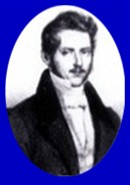




Bertin's Le Loup-garouOpera Southwest, Albuquerque, September 9-11, 2022 Charles Jernigan,
September 17 2022 Photographs kindly
provided by Opera Southwest
Bertin is that rara avis, a female opera composer from the early nineteenth century. The Women’s Philharmonic Advocacy has published an evolving list of 847 operas by women, starting in the seventeenth century with Francesca Caccini’s La liberazione di Ruggiero dall’isola d’Alcina, 1625. Many of these women were wealthy aristocrats who could afford private tutoring or they were connected through family or marriage with men who were composers themselves: Caccini’s father Giulio was a founder of opera as an art form; Pauline Viardot was a famous singer whose father was a teacher, singer and composer; Amalia, Princess of Saxony (1794-1870) was a noblewoman who wrote at least fourteen operas. Louise Bertin (1805-77) was neither an aristocrat nor married to a composer, but she came from a progressive and well-connected artistic family in Paris as Bennett pointed out. Her father was Louis-François Bertin, the long time editor of the Journal des débats, a major Paris weekly which began in 1789 at the time of the Revolution. It had gone through several political evolutions, but in Louise Bertin’s time, it was a major, if controversial, publication attracting important contributors in the arts, politics and culture. Hector Berlioz published music criticism in its pages and Alexandre Dumas père and Victor Hugo were among its literary contributors. Louise herself suffered from a disability, probably the result of a childhood illness or accident, which made it difficult for her to walk or stand for long periods; she never married. She showed such talent for music and literature that her father saw to it that she was trained in music by the best available teachers, François-Joseph Fétis and Anton Reicha. Fétis was a musicologist, critic and composer as well as a teacher, and one of the most influential figures in the Parisian world of music in the nineteenth century; Reicha, a professor at the Paris Conservatoire, was also a composer and theorist who counted Berlioz, Liszt, Gounod and Pauline Viardot among his pupils. Louise wrote the first of her four operas, Guy Mannering after a novel by Walter Scott under Fétis’ tutelage. She herself wrote the libretto, and it was given a private performance for the family in 1825 when Bertin was only twenty—with Rossini in the audience. In March, 1827, Bertin made her professional debut as a composer at the prestigious Opéra Comique with Le Loup-garou (The Werewolf), to a one act libretto by Eugène Scribe and Edouard Mazères, who were among the best-known librettists of the age. Bertin was 22. Even before writing Le Loup-garou, Bertin had started to work on a projected opera based on Goethe’s Faust, which began to appear in French translation at that time. This she destined for the Théâtre-Italien, one of the three important opera theaters in the French capital, where only works in Italian were presented. Fausto, a melodrama semiseria, was intended to follow the common Italian tradition of a woman performing en travesti—that is, a mezzo-soprano singing the titular role of Faust. The projected singer was no less than Maria Malibran, then the most famous diva in Europe. Bertin herself wrote the libretto of Fausto, in Italian [1]. For reasons which remain unclear, the premiere was postponed for a year and Malibran was no longer available, so Bertin recast the role for the fine tenor Domenico Donzelli, and the premiere took place in March, 1831. It was the first opera in France based on Goethe’s Faust, coming fifteen years before Berlioz’ Damnation of Faust and several decades before Gounod took up the challenge with his own Faust in 1859 [2]. Although the opera was not a success with the public, it did enjoy some critical praise. Bertin’s last opera, premiered in 1836 at the Académie Royal de Musique (the Paris Opéra), was La Esmeralda. In spite of an all-star cast, a spectacular production and Hector Berlioz directing the rehearsals, it failed after seven performances for reasons which have nothing to do with the quality of the music. Bertin was accused of using her family’s influence to get the opera produced, and many (including Dumas père) thought that the best music was really by Berlioz (especially the most popular aria, the Aire des cloches (the Bell Aria). The production foundered because of antipathy to the Bertin family’s politics and the political leanings of their Journal des débats. Bertin was only 31, and although she lived for another four decades, she never wrote another opera. Until now, La Esmeralda is the only one of Bertin’s operas to have had a modern performance—in Montpellier in 2008—and a CD recording; it is available on You Tube. Thus a woman—with a serious disability, no less—dared to challenge all three types of opera available to her in the Paris of her day—an opéra comique with spoken dialogue, an Italian opera semiseria for the Théâtre Italien and a grand opera for the Académie Royal. In the late eighteenth and early nineteenth centuries a few other women wrote (and had produced) comic operas in Paris, but, so far as I know, Louise Bertin was unique in producing a tragic grand opera for Paris’ principal theatre and an Italian melodrama for the Italiens. Le Loup-garou Le Loup-garou had its modern debut this month at enterprising Opera Southwest in Albuquerque, New Mexico [3], the third of Maestro Anthony Barrese’s exhumations of unknown operas from the nineteenth century [4]. First, we should note that there is no werewolf in The Werewolf. Instead, the libretto might be seen as satire on the Romantic Gothic tradition of ghosts, vampires and werewolves, so popular at the time in Germany and Britain, laughed off with Gallic irony pointed at superstition. The Germans might have produced ‘supernatural’ operas like Der Freischütz (1821) and Der Vampyr (1828), but the French answer to German spookiness was something like La dame blanche (1825) or Le Loup-garou (1827) where the ‘supernatural’ is explained naturally.
Alice and Catherine are two orphaned young women who live under the protection of Raimbaud, the custodian of a castle belonging to the exiled Count Albéric in a village in Burgundy. Alice is preparing for her wedding to Bertrand, a local falconer chosen for her by Raimbaud (“Reçois, jeune fiancée”). Once the girls are alone, Catherine reveals that she is in love with Bertrand in spite of his doltish nature. Alice, for her part, reveals that she is not in love with Bertrand, but with a handsome young man who has rescued her when she slipped and fell into a torrent (Romance, “Le Soleil dans la plaine”). What can they do to stop the wedding, which should have taken place that very day? Bertrand is superstitious and won’t marry on a Friday, however, and the wedding has been postponed for 24 hours, giving the girls a respite. Bertrand has been out hunting without success for a wolf which has been ravaging the land and for which a reward has been posted. When he returns empty-handed, he tells Rambaud that these wolves come out only at night because they are werewolves! Raimbaud ridicules these ideas and wants to get on with the betrothal dinner, but Bertrand is unwilling to attend because—horror— there will be 13 guests, an unlucky number! Catherine is charged with finding a fourteenth guest so the banquet can proceed. Meanwhile, Alice tells Bertrand that she doesn’t love him, and Bertrand guesses why. She has fallen for a certain Hubert, a mysterious figure who lives in the forest and may be an outlaw. In fact, Bertrand has seen him enter a cave and emerge when the clock struck nine as a wolf—a werewolf! Alice is shocked and confused since it is Hubert whom she loves. Catherine enters with a young man whom she has found to make the fourteenth guest at the betrothal banquet. To Alice’s shock and the man’s delight, it is Hubert. (Trio: “O surprise/bonheur extreme”). When Bertrand enters, he too is shocked to see “Hubert,” and the trio becomes a quartet. Bertrand calls Rambaud, and the quartet expands to a quintet, as Rambaud recognizes that “Hubert” is actually his master, the exiled Count, Albéric. In dialogue, “Hubert” explains that he was looking for Rambaud when a pretty girl invited him to dinner at Rambaud’s very house—and a welcome thing it is because he is starving. Bertrand fears that he is more interested in eating people than sheep. When “Hubert” learns that Rambaud has chosen Bertrand as Alice’s husband, he asks for Alice’s hand himself if Rambaud’s consent can be obtained. Rambaud readily agrees since he knows that “Hubert” is really Count Albéric, but to the shock of all she refuses, believing the story that he is a werewolf. Bertrand offers her his arm and they go inside for the ceremony. Left alone, “Hubert” and Catherine lament their fates: he has been betrayed by the woman he loves and she is shocked that Alice has not chosen the man she loves—and left Bertrand for her. “Hubert” explains that he has been exiled by the Duke of Burgundy for fighting duels over women and he can come home only if he marries. He thought that Alice would make a fine bride, but now he asks Catherine if she will marry him! Rambaud, knowing that he must marry to end his exile, and looking for a match for Catherine, agrees (Ensemble: “Dame de ma pensée”)—to the consternation of the others. “Hubert”/Albéric tells Raimbaud to bring Catherine to meet him in the forest at la Tourelle at nine that evening, where he will rendezvous with his entourage. Now everyone leaves except for Catherine, who is soon joined by Bertrand. He reveals his doubts about marrying Alice because for some time he has been in love with her—Catherine—and he soon asks her to marry him instead of Alice. But wait—Catherine is now engaged to “Hubert”! When Bertrand hears that they are to meet “Hubert” in the forest at nine, he is convinced that at that hour “Hubert” will become a werewolf. He sets out to kill him with his long rifle (harquebus). With all of the hunters gone to kill the werewolf, Alice locks “Hubert” in a room to keep him from going to the forest and being killed, but she is terrified that he will become a werewolf when nine strikes. Albéric/“Hubert” is thoroughly confused, but when the nine o’clock bell tolls, Alice drops her torch, plunging the scene into darkness (Duet, “Hélas! Hélas! N’approchez pas”). Soon he understands that Bertrand has spread the rumor that he is a werewolf and that Alice is trying to save him in spite or her terror. She does love him! Before the duet ends Albéric is declaring his love for Alice and she is no longer afraid. Now all the villagers enter with Bertrand carrying a wolf’s head in his hand. He is astonished to see “Hubert” still alive and is going for his rifle when Raimbaud tells him that the mysterious “Hubert” is really Count Albéric, who keeps his marriage offer to Alice. Bertrand offers a touch of irony on the situation (“So she refused me to become a countess!”), but everyone celebrates the two happy couples.
Eugène Scribe was the most famous librettist in the world at the time of this opera, and his frequent collaborator, Edouard Mazères, was a prolific playwright. Bertin had access to the best, but the libretto came in for some criticism at the world premiere. Still, the audience liked the music well enough and the opera enjoyed a run of 27 performances—the most of any new work that year at the Opéra Comique and a longer run than a new opera by Bertin’s teacher Fétis. There is a long and pleasant overture with some music we will hear later in the opera [5]. Alice’s Romance in the second scene is the only solo piece in the work.[6] All of the other music is in ensembles, many of which are handled in surprising ways, expanding from two singers to three or more. The melodies are gracious and even memorable after a couple of hearings, and are for the most part fairly simple. The vocal lines are unadorned compared to the contemporary music of Rossini or even composers like Hérold and Auber. There is no doubt, however, that Bertin knew her stuff; the ensembles are clever and well developed. Rossini knew Bertin and she certainly knew many of his operas, but with a couple of exceptions this work does not sound much like Rossini even though the structures can be compared to his short one-act works, most written early in his career. The concertato-like ensemble which comes a little more than half way through the 75 minute work is Rossini-like, particularly the stretta and a clever syncopated duet between the tenor Albéric and Alice near the end might be at home in a Rossini comedy. Bertin, however, has her own voice, her “sound,” in the plaintive Romance and elsewhere. It might have been a “sound” that was in a stage of development in 1827 when she was only 22, but it is hers. The Opera Southwest production was simplicity itself—no sets, few props and simple costumes. Thankfully it was played straight, as Scribe and Mazéres intended. The extensive spoken dialogue did not seem to be cut and was rendered in English with amplification for the outdoor setting while the musical numbers were sung in French and unmiked. The sold out audience at the first two of three performances appreciated the jokes and laughed as they should. At the first of two performances we saw (on Sept. 10) a ferocious wind blew throughout the performance, throwing off the singers and orchestra to a degree, but they soldiered on. The Sunday night performance (Sept. 11)—without wind—was much better. Maestro Anthony Barrese had prepared the score and trained the singers and the orchestra, and he conducted with his usual appreciation for the lyrical moments. His experience with Rossini showed in the drive of the allegros and crescendoing ensembles. The singers were all Apprentice Artists. Yejin Lee (Alice) had secure high notes and a pleasing sound, and she was lively when she needed to be. Melanie Ashkar (Catherine) exploited her low notes nicely and Thomas Drew (Bertrand) and Miguel Pedroza (Rambaud) were just fine. Michael Rodriguez as Comte Albéric/ Hubert aka “Le Loup-garou” had a sweet though powerful tenor voice and could produce a really dulcet sound at times. Although the youthful singers were not always comfortable in delivering spoken dialogue and were hardly practiced in the exaggerated speaking style which Opéra Comique audiences would have expected, the lines came across clearly. In addition there was a an eight person chorus. Elizabeth Margolius directed the staging effectively enough, the minimal lighting was by Patricia Goodson and Alyssa Salazar was responsible for the simple costumes, although I wish someone had provided a wolf’s head for Bertrand as called for in the libretto. An additional treat was Denise L. Boneau, who wrote her Ph.D. dissertation on Bertin under Phillip Gossett at the University of Chicago. Boneau had come to Albuquerque so that she could finally hear the work she had dreamed of hearing live for many years; she gave an informative talk on Bertin before the performance. Opera Southwest’s season continues with a new opera, Zorro, by Héctor Armienta (Ft. Worth Opera premiered the opera last January in a pared down version with piano and guitar, but this will be the first fully staged and orchestrated version) and Rossini’s Le Comte Ory. It is hardly a standard season full of Bohèmes and Carmens, yet the Albuquerque audiences seem to revel in the unusual. In Douglas Bennett’s initial article, he asked the question as to whether Louise Bertin was a “dilettante or an icon.” Twenty years later, I would say that she has not become a feminist icon since even now few have heard of her. After listening to La Esmeralda and after seeing Le Loup-garou, I would argue that she was certainly not a dilettante. If Hugo was willing to write his only libretto for her; if Berlioz considered her worth his time; if Rossini was willing to produce her Fausto at the Thèâtre Italien, they must have considered her a worthy composer. Now, it seems, her time has come.
*************
Le Loup-garou was performed in the outdoor Amphitheatre of the Albuquerque Museum in the historic Old Town quarter of the city. Later in the season, the operas will be indoors at Opera Southwest’s usual venue, the Albuquerque Journal Theatre in the Hispanic Cultural Center. The plein air performance could be moved into the museum in the event of rain, but that is a rare occurrence in Albuquerque in summer, other than brief thunderstorms.
[1] Or perhaps she wrote it in French and it was translated into Italian by Luigi Ballochi. [2] Fausto is to be given its first modern hearing in a concert performance at the Théâtre des Champs-Elysées in Paris on June 20, 2023. It will be in the original version with a mezzo-soprano (Karine Deshayes) singing Fausto. [3] A version of the opera (with werewolf added) took place in Massachusetts in 2017 by Whole Tone Opera with a rewritten libretto which made it a “fiercely queer opera” in accord with the company’s mission to serve the LGBTQIA community. Gothic Opera in the London area plans performances at Halloween, 2022 where Le Loup-garou will be paired with Viardot’s Le dernier sorciere. Both of these versions are with small chamber ensembles, which makes Albuquerque’s version with full orchestra a modern world premiere. [4] After Faccio’s Amleto and Bottesini’s Ali Baba. [5] It has already been programmed by the Seattle Symphony for performance this fall [6] Bertin wrote a second aria for Alice (No. 5A) which appears in a piano reduction, but orchestration material has not yet been located and the aria was not performed in Albuquerque. |


