




Donizetti's Maria StuardaSoeul, 2019 Russell Burdekin, Donizetti Society Newsletter, no. 142, March 2021, pp. 22 - 24.
Rooting around online during the Covid crisis, I came across a South Korean production of Donizetti’s Maria Stuarda. Of particular interest was that it was a totally Korean production without any apparent Western involvement. It was the South Korean premiere and followed on from a 2015 performance of Anna Bolena. Lee Changeun (Romanized names are used throughout), the artistic director of La Bella Opera who staged the performances, was kind enough to send me some background articles. These also led me to a brief, superficial, but hopefully not too inaccurate, look at the current state of opera in Korea. Where necessary, I’ve relied on Google for translation.
Traditional types of opera have a long history in Korea but public, theatre-based, performances only started in the early 20th century. Western opera had its first performances in 1948; apparently the organiser ended up having to sell his house to pay for it. It is now very much alive in South Korea although still a minority interest. There is the Korean National Opera, which stages an opera over about 3 days or so each month at the modern, multi auditorium, Seoul Arts Centre and occasionally tours smaller venues. There are also a small number of other companies, like La Bella Opera, most of which are based in Seoul. La Bella Opera produces 5 or 6 shows a year, but not all opera. Despite this Seoul focus, Deagu sees itself as the heart of opera in Korea with its opera house, which opened in 2003 (L’elisir d’amore is scheduled this year), an opera school and an annual opera festival. A spectacular opera house is also nearing completion at Busan. The repertoire is essentially mainstream 19th century but with occasional forays into more unfamiliar territory with works like Monteverdi’s L’Orfeo. There are also a number of new Korean works, possibly partly to help overcome audience resistance to opera as a purely Western entertainment.
Opera in South Korea faces the same funding challenge as opera everywhere, but they start from a much more disadvantageous position than most. A recent report stated that average ticket prices were around £25, which is apparently nearly a third higher than those for musicals and three times higher than traditional Korean music concerts. In fact, looking at current shows, the ticket price disparity did not seem so marked. There is also some sponsorship and some restricted state support. Whether or not ticket prices are a dampener, ticket sales are sluggish leaving companies to distribute many complimentary tickets, in 2016 only 36.5% of tickets were purchased. Perhaps a more satisfactory trade-off between ticket prices and ticket take-up could be found but getting people to give opera a try is the heart of the problem. It is claimed that Koreans believe “that opera is awkward” (difficult to understand?). One answer to this has been to reinterpret works “to be more familiar to modern Koreans”, whatever that might imply. Operas are sometimes deemed too long, but it is not clear whether this is because of past theatre going experience or, as has been cited for younger audiences’ disinterest in the West, due to shorter attention spans resulting from online culture.
Thankfully, the Maria Stuarda was not reinterpreted and was complete except for a few, not unusual, omissions, such as the repeat of Maria’s opening cabaletta (their Anna Bolena had been shortened by 30 minutes). The opera was staged in Seoul on November 22-24, 2019, four performances, double cast. The performance streamed had Kang Hye-myung as Maria, Ko Hyun-a as Elizabeth, Shin Sang-geun as Leicester and Lim Hee-sung as Talbot. Of the four, Kang and Ko have sung in European houses and Sing at the Met. One notable aspect of all the singing was the clarity of the Italian.
The direction by Lee Hee-soo was straightforward and well thought out and contrasted favourably with David Alden’s rather diffuse and gimmicky production from Zurich streamed in September. Some of the show’s advertising talked of the production expressing “the gorgeous and magnificent English and Scottish royal backgrounds of the 16th century. The visual splendor and dynamic stage that will perfectly recreate the appearance of European royalty”. This was rather overselling it, but suggests that opera in Korea needs to claim the visual experience in opera as something different and unique. In fact, the staging was fairly minimal. The opening scene just had a series of vertical galleries on each side for the chorus. The central stage lights were part of a tangle of bars representing a crown of thorns and this idea was carried over in the branches of the stylised tree, which represented the forest in the next scene. The martyr theme was repeated in the final scene where a huge cross was placed against the back wall of the stage. There was some imaginative use of lighting; I particularly liked Elizabeth stalking out of the gloom to demand Mary’s letter from Leicester.
The chorus, the male soloists and Anna were all dressed soberly in what seemed to have as much a touch of the Far East as of the Tudor about their clothing. Where clearly much effort and expense had been lavished was in the two queens’ dresses. These were gorgeously rich and colourful and ensured that the focus was almost exclusively on the two queens. Rather oddly, they came out in a different dress for each of their appearances, which I suspect was a way of ensuring that the audience felt that they had had their expected fill of spectacle, a sentiment reflected in website comments.
I very much enjoyed the Elizabeth of Ko Hyun-a. After a slightly bumpy start, it was a lively and insightful performance that made the most of her opportunities with nimble switches between the imperious and the hesitant. I was less convinced by Kang Hye-myung’s Maria. There could be no question about her singing and the quality of her voice, she had covered for Renée Fleming at one point in her career, but it seemed a rather one-dimensional portrayal. This might partly have been down to the contrast with Ko’s vivid Elizabeth or perhaps an overemphasis on Maria as martyr but it seemed more that Kang was intent on the musical line at the expense of her acting. The result, to a Western eye, was sometimes a little “stagey” with overemphatic gestures and singing at the audience rather than to the person being addressed, both occasionally also found with the other singers. Given their experience on Western stages, it would be interesting to know whether these differences were influenced by the wider movement to meld Western acting styles with more traditional Korean artforms, which include puppetry, masques, mime and Pansori (a type of formalized singing) and by audiences’ expectations of stage action.
The male roles in the opera are a bit thankless but the principals certainly did not let the production down, particularly Lim’s sonorous Talbot. The chorus was fine vocally but their inexperience or lack of rehearsal showed in self-conscious stage movement. The New Seoul Philharmonic Orchestra under conductor, Yang Jin-mo, gave a good account of the score but perhaps he could occasionally have taken a firmer lead. The final scene summed up the care and thought behind the production. Rather than an executioner’s block or hooded axemen, Lee had Maria stand on one side of the revolving stage with Elizabeth leading the heir, James, on the other. As the stage revolved and Maria moved into the shadows, James moved into the light. Overall, this was a distinctive and refreshing production that measured up well against those from Western companies while also reflecting some of the constraints that Korean opera has to work within. One can only hope that their efforts will find an increasingly appreciative audience.
The video can be found at
|
Maria - Kang Hye-myung / Ida-mi
Elizabeth - Ko Hyun-a / Oh Hee-jin
Leicester - Shin Sang-geun / Lee Jae-sik
Talbot - Lim Hee-sung / Choi Byung-hyuk
Cecil - Yang Seok-jin / Lee Jun-seok
Conductor - Yang Jin-mo
Director - Lee Hee-soo
The photos are taken from the video listed above, which had the initial cast.
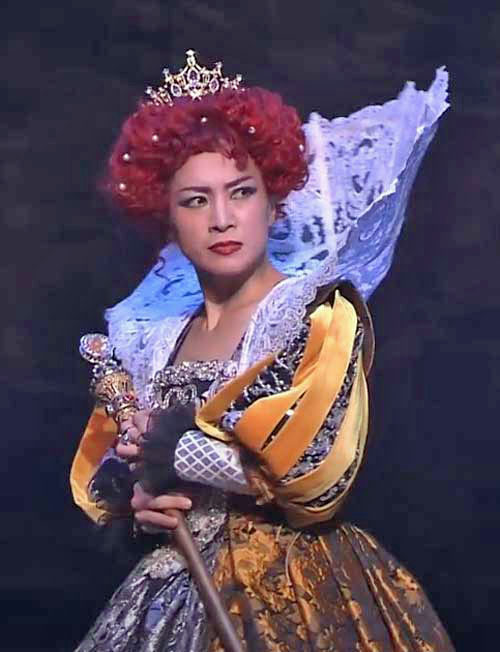
Elizabeth
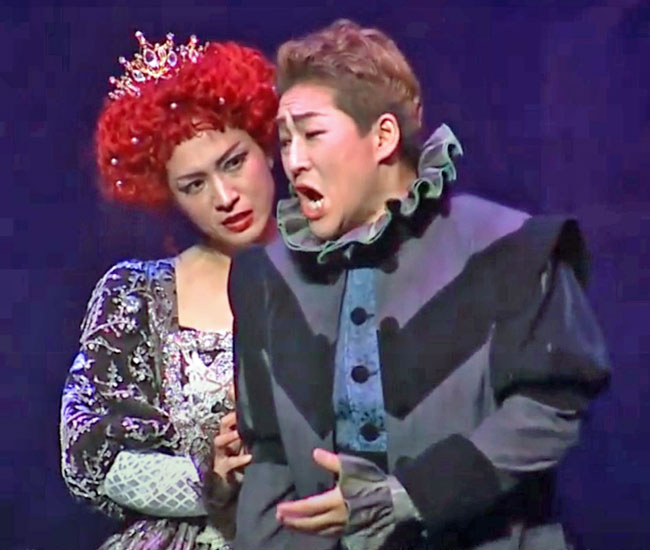
Elizabeth and Leicester
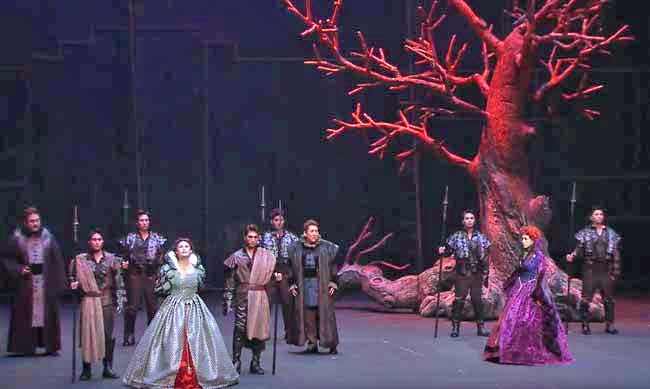
The Confrontation between Maria and Elizabeth
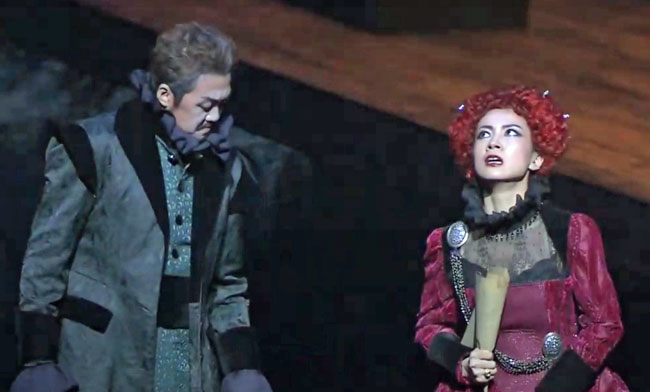
Cecil and Elizabeth
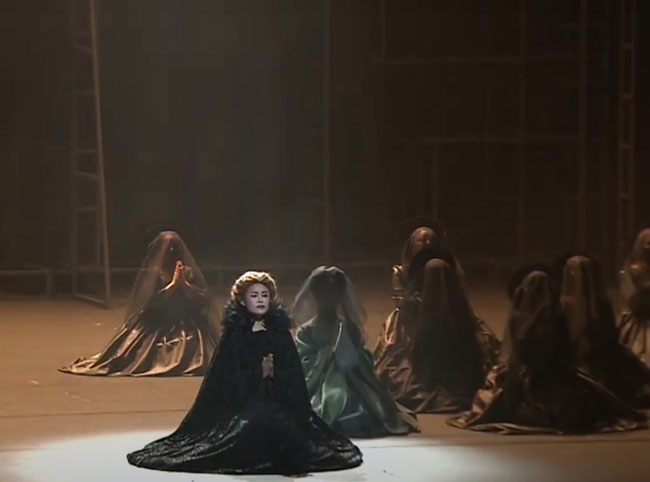
Maria's prayer
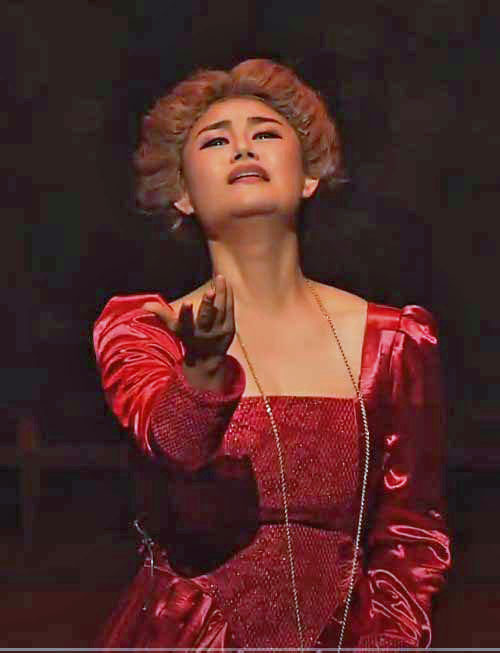
Maria

