



Meyerbeer's Le Prophète
Théâtre du Capitole, Toulouse, June 23 - July 2, 2017 Photographs by Patrice Nin, courtesy of the Théâtre du Capitole This was a new production. Miles Gaythwaite saw the final performance on July 2 and has provided the following.
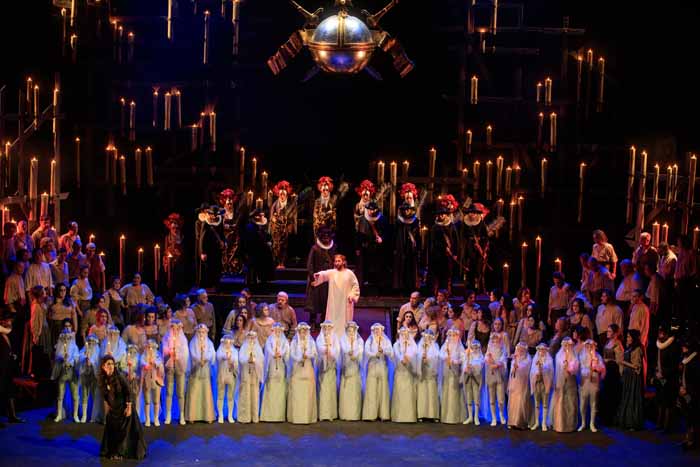
A memorable afternoon at the Capitole seeing and hearing Le Prophète in a new and sumptuous production with first rate voices, an excellent and very large chorus, good dancers and the orchestra in great shape. Meyerbeer wrote four operas for the Paris Opéra which in the 19th century were very popular. Le Prophète is the third of these, the others being Robert le Diable, Les Huguenots and L'Africaine. Nowadays they are all rarities (even in France) and this performance was the first I had ever seen. Usually the opera performances at the Capitole draw full houses, but I was surprised to see so many empty seats at this performance. I would say that the auditorium was only about 70% full.
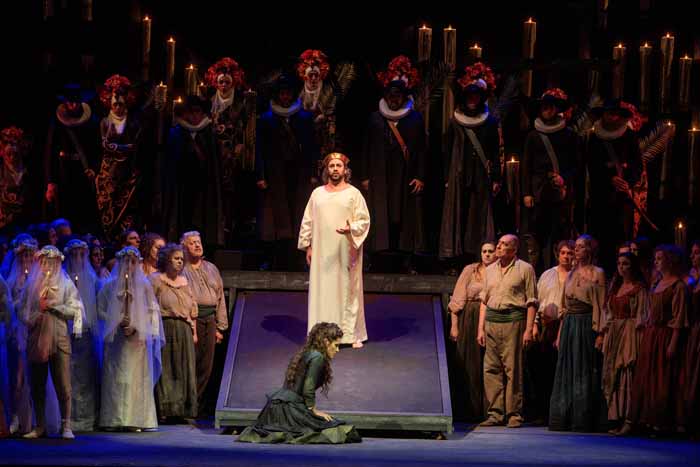
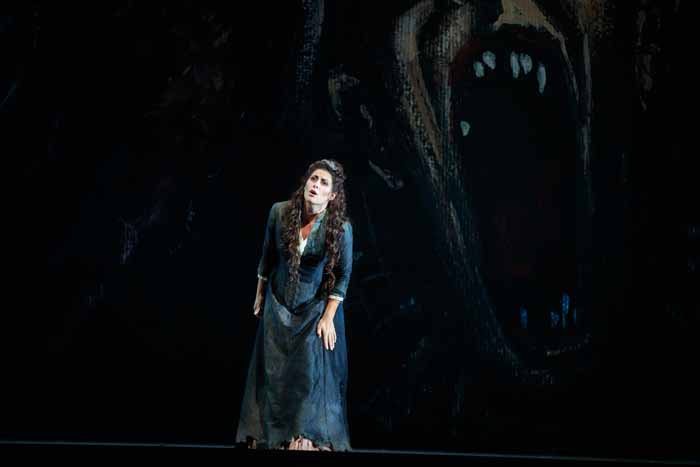
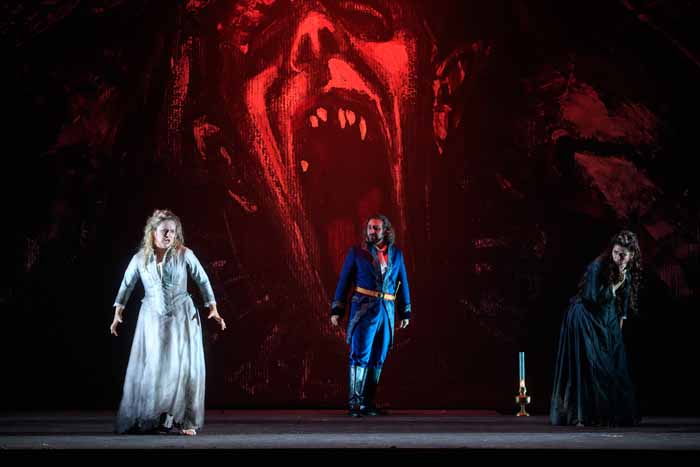
Probably one of the reasons for these operas being so rare is that they are very difficult to cast, as they were written for individual singers and nowadays it can be very hard to find principals who can sing these parts satisfactorily. However the Capitole had three very good singers for the lead parts, the overall star was Kate Aldrich who sang the mezzo soprano part of Fidès. However the part of Jean de Leyde which was filled by the tenor John Osborn, was not far behind. The third was Sofia Fomina (soprano) who sang Berthe very decently. Oddly enough Fidès and Jean were sung by Americans both of whom had very acceptable French pronunciation. The comprimarios were also very good and, as is usual at the Capitole, the extensive rehearsals ensured that the ensembles were very well done. As is now common at the Capitole the chorus were first rate and I would guess there were about 70 to 80 singers involved. This opera also contained a lot of dancing but in this performance the ballet had been cut down considerably. Even so the whole performance took just about 4 hours (intervals included). I am no expert in matters of ballet but my feeling was that the dozen or so dancers were very good indeed too, as the Capitole has its own ballet company.
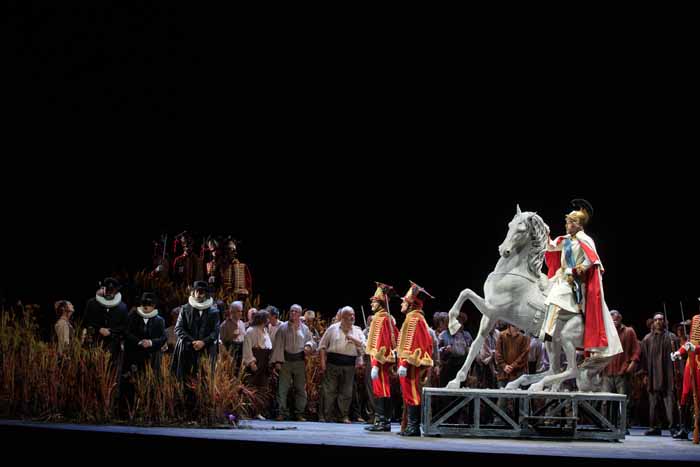
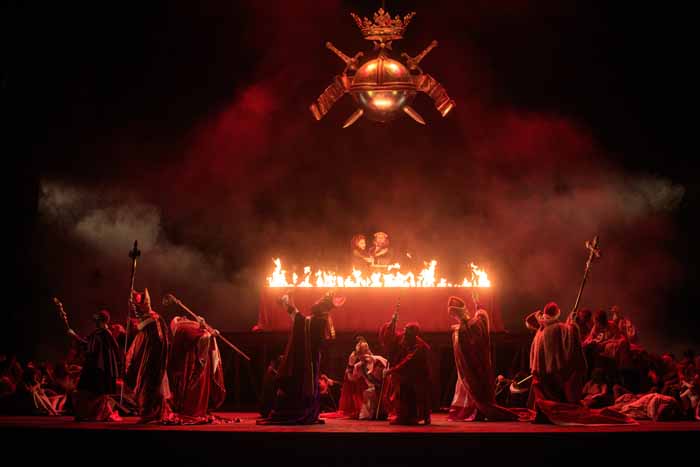
Claus Peter Flor was the conductor and he did a very fine job of bringing the large orchestra together. Also as he is no stranger to the pit of the Capitole he kept the orchestra from drowning the singers. The coronation scene called for another 15 players on stage and it looked very much as though this was indeed taken seriously. The production was very acceptable it was set as a period piece and the costumes gave witness to that. There were two or three very grand scenes, notably the coronation and the final immolation at the end. When it comes to the music I realised that there were a number of pieces of music from this opera with which I was familiar, but I had never known that they had been written by Meyerbeer nor that they came from this opera. The Coronation March and the Skating Music are examples of these. Meyerbeer was clearly a very competent composer and was able to use unusual combinations of instruments and voices to achieve particular effects. I don't think that one could be quite so enthusiastic about Scribe's libretto, which apart from being much too long, was fairly unconvincing overall.
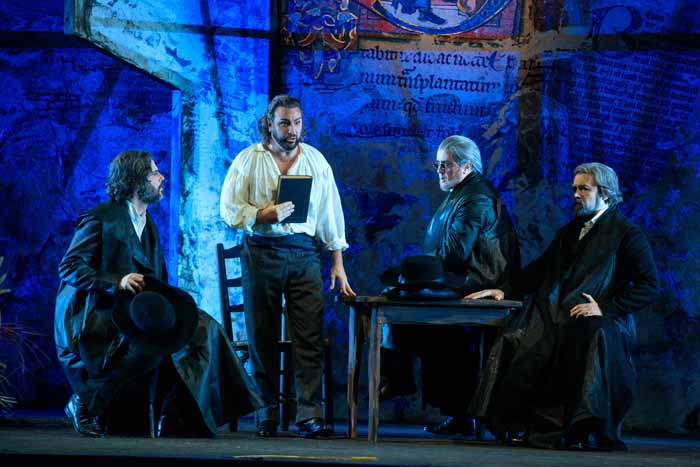
There are a couple of separate strands to the plot. Firstly Jean de Leyde wants to marry Berthe but she is the fief of her overlord Count Overthal, and she needs his permission to wed Jean. This permission is not forthcoming and Berthe and Fidès (Jean's mother) are seized to prevent their thwarting this command. However this very high-handed behaviour of the Count causes trouble amongst the populace. This part of the libretto is not unlike Cammarano’s libretto for Louisa Miller, which also premiered in 1849 and is, I think, rather better. The second major strand is that there are three Anabaptists who are looking for the new messiah. They have noticed that Jean looks quite like the picture of King David in the cathedral. On that rather flimsy basis they try to persuade Jean to become the new messiah. Things are made worse as Jean says that he has been having dreams to the effect that he will soon become a king. One of the major problems of Jean becoming the new messiah is that he cannot admit to having a human mother, hence Fidès would have to be publicly disowned.
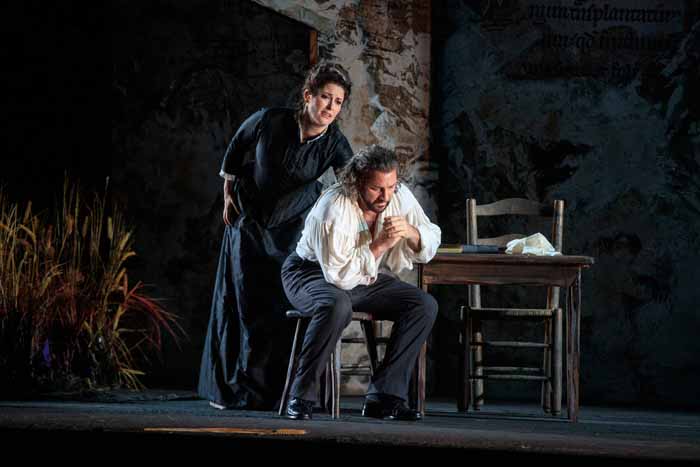
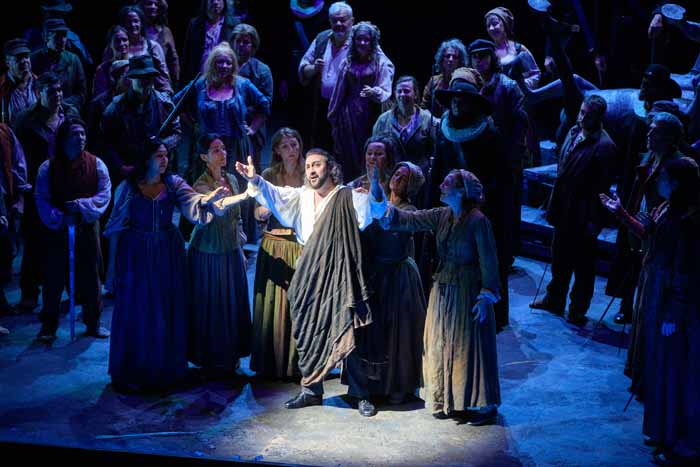
There are passages in this opera which are very good indeed and make good musical theatre. The reluctant public repudiation by Fidès of Jean being her son was a good example of that and even better the later music in act 5 in which Fidès muses bitterly over the way Jean had treated her for his own ends. When he comes to apologise to her for this and make amends her reactions are very interesting. At the end of that scene Fidès becomes reconciled with her son, but Berthe is not to be persuaded. This leads to the final showdown when the people realise that Jean is not the son of God but very much a human and which precipitates the fire that consumes them all. Actually that scene was not wholly successful as it looked a bit like a giant barbeque. So overall it was well worth attending not only in broadening my knowledge of Meyerbeer but with the music giving much enjoyment even if it is perhaps a rather patchy opera.
|
The Team
|
Jean de Leyde - John Osborn Fidès - Kate Aldrich Berthe - Sofia Fomina Jonas - Mikeldi Atxalandabaso Mathisen - Thomas Dear Zacharie - Dimitry Ivashchenko Le Comte d’Oberthal - Leonardo Estévez
Mise en scène - Stefano Vizioli Décors et costumes - Alessandro Ciammarughi Lumières - Guido Petzold Mouvements chorégraphiques - Pierluigi Vanelli
Orchestre national du Capitole Choeur et Maîtrise du Capitole
|
|
© Patrice
Nin/Théâtre du Capitole Zacharie, Jonas, Mathisen, Le Comte d'Oberthal
© Patrice Nin/Théâtre
du Capitole Mathisen, Jean de Leyde, Jonas, Zacharie
© Patrice Nin/Théâtre
du Capitole Fidès and Jean de Leyde
© Patrice Nin/Théâtre
du Capitole Jean de Leyde
© Patrice Nin/Théâtre
du Capitole Fidès and Jean de Leyde
© Patrice Nin/Théâtre
du Capitole Fidès and Jean de Leyde
© Patrice Nin/Théâtre
du Capitole Fidès
© Patrice Nin/Théâtre
du Capitole Berthe, Jean de Leyde and Fidès
© Patrice Nin/Théâtre
du Capitole Finale
|