|
|
|
|
|
|
|
|
|
|
Donizetti's Roberto DevereuxBayerische Staatsoper, Munich, September 23, 2011 - February 13, 2012.Photographs by Wilfried Hösl, courtesy of the Bayerische Staatsoper, Munich.
In 2012, the Bayerische Staatsoper revived, yet again, its 2004 production of Donizetti's Roberto Devereux, all of which have starred Edita Gruberova. Perhaps because it was a revival, there appears to have been only one review, which was by Gilles Charlassier on ConcertoNet.com. He entitled it "Le crépuscule d’une idole" and gave a depressing account of how time has taken its toll on Gruberova's voice while noting that she was still able to generate great enthusiasm with the audience, dryly commenting "L’amour n’a pas d’oreilles". Perhaps Gruberova herself has also now acknowledged that her illustrious career is coming to an end with an announcement of her retirement from the Bayerische Staatsoper in 2014. Below are photographs and some comments from a happier time, the original 2004 production.
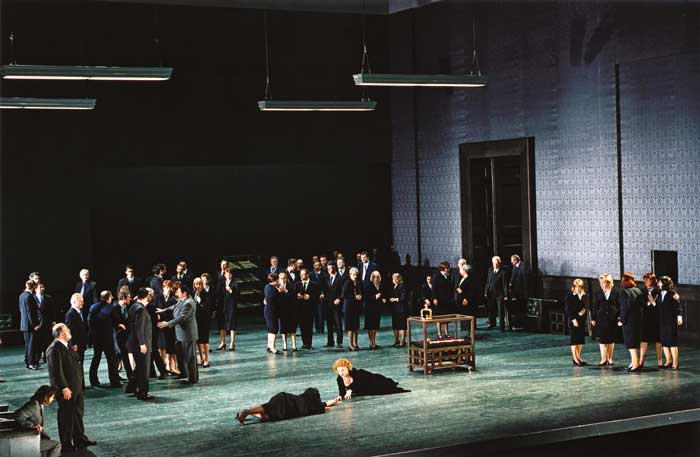
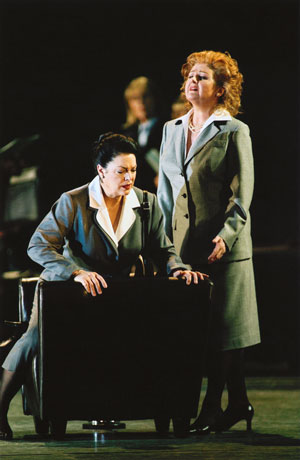
Comments on the February 5, 2004 performance Director Christof Loy and designer Herbert Murauer updated the opera with suits and settees in place of doublets and thrones, an unlikely approach given the specific historical subject but one which worked very successfully. There was a single basic set of high grey walls with long vertical windows furnished as a rather formal and impersonal lounge with cleaners dusting and polishing the floor during the overture. The main variation on this set was the very irritating idea of lowering a black curtain halfway down to restrict the view of the stage for the more private scenes. Loy has a great gift for creating the extraordinary out
of apparently ordinary situations.
Sometimes he does this by injecting humour, which, on reflection,
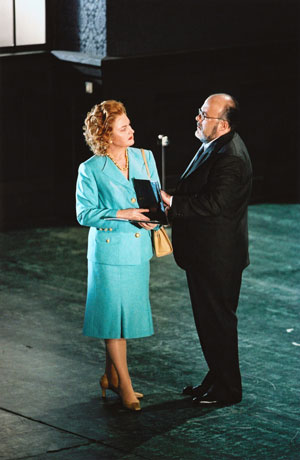
deepens the response to the drama. Thus Elisabeth was portrayed as a Mrs Thatcher
figure with powder blue suit and handbag, hastily getting out her compact and
swallowing a pill to ensure that she is at her brightest and best when the
beefy Roberto enters to plead his case.
The courtiers singing of their fear for Roberto’s fate were dressed as
palace staff reading tabloid newspapers, whose headline was, apparently, along
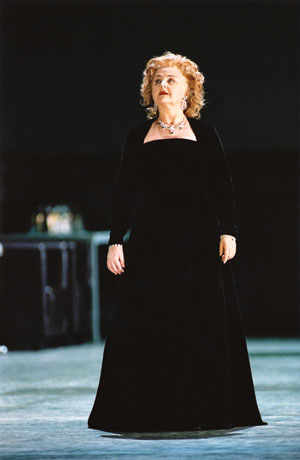
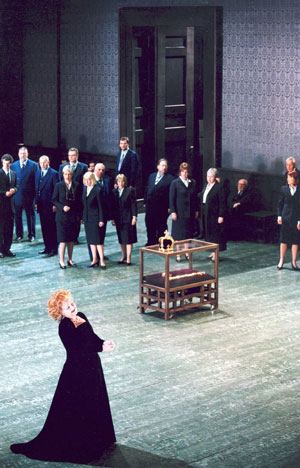
the lines of “Essex for the chop”. At other times, Loy gives us a searing or startlingly memorable image. In this production, to prevent his wife, Sara’s, escape, Nottingham ties her up and blindfolds her leaving her lying helpless at the front of the stage. During the tender and moving prelude to Roberto’s final aria before his execution, Sara slowly, almost imperceptibly, slid herself to the side of the stage, an animal crawling away to die. Roberto then enters from the other side, also blindfolded, the two at last in a sense united but doomed not to know it. When Sara is freed and rushes to tell Elizabeth, she and Elizabeth crawl towards each other across the stage their hands outstretched each looking for help from the other until Elizabeth realises Sara is her rival. Finally, the distraught Elizabeth reflecting on the blood that has been spilled and the intolerable emptiness and delusion of her existence pulls off her wig to reveal a head of sparse, scraggy, grey hair, her last deception stripped away and announces that James will be king. Elizabeth was Edita Gruberova, not that far short of 60, but singing and acting with a facility and imagination that put her in a class of her own and sounding better than her recording of nearly a decade ago. One might quibble that the part needs a more dramatic voice and that the sheer beauty and artistry of the voice drew one away from the drama, even though there were no superfluous cadenzas or the like, but I doubt that few would have wanted to exchange it, certainly not the Munich audience that night who were still clapping when we left after some dozen or more curtain calls. Paolo Gavanelli, a powerful and resonant Nottingham was also outstanding. Jeanne Piland, as Sara, started a little hesitantly and Zoran Todorovich, as Roberto, initially sounded as if he was having to force his voice despite the Nationaltheater’s superb acoustics but both came into their own in Act 3. As might be expected, Friedrich Haider, Gruberova’s husband, conducted a lively and sensitive accompaniment from the Bayerische Staatsorchester and the chorus was very impressive in both their acting and depth of sound. Interestingly and deservedly, after an initial solo bow from Gruberova, the soloists and conductor came out together for the calls reflecting that it had been a wonderful team effort not just a one woman show. Rather endearingly, Gruberova had put the initial Maggie Thatcher wig back on over the scraggy one – there’s only so much a prima donna is prepared to do for her art.
The Team (2012)
Elisabetta - Edita Gruberova Duke of Nottingham - Devid Cecconi / Fabio Capitanuccii Sara, Duchess of Nottingham - Carmen Oprisanu / Sonia Ganassi Roberto Devereux - José Bros / Joseph Calleja / Alexey Dolgov Lord Cecil - Francesco Petrozzi Sir Gualtiero Raleigh - Steven Humes / Goran Juric / Tareq Nazmi Ein Page Robertos - Nikolay Borchev / John Chest
Conductor - Friedrich Haider Production - Christof Loy Set and Costumes - Herbert Murauer Lighting - Reinhard Traub Dramaturgy - Peter Heilker Chorus - Sören Eckhoff
The Bavarian State Orchestra The Chorus of the Bavarian State Opera
Photographs from the 2004 original production Elisabetta - Edita Gruberova Herzog von Nottingham - Paolo Gavanelli Sara - Jeanne Piland Roberto Devereux - Zoran Todorovich (unfortunately, the opera house provided no photographs of him)
© Wilfried Hösl Elisabetta
© Wilfried Hösl Sara and Elisabetta with the chorus
© Wilfried Hösl Elisabetta with Nottingham and with Sara
|
|
|
|
|
|
|
| © Donizetti Society and contributors, 2004-2012 |