|
Nini's La Marescialla d'Ancre
Teatro Pergolesi, Jesi, Le Marche, Italy,
September, 26 & 28, 2003
The pictures provided by the Teatro Pergolesi of their
production of Nini's La marescialla d'Ancre.
The
recorded extracts (♬) are taken
from the recording of the 2003 Jesi production on Bongiovanni
GB2362/63-2, courtesy of Bongiovanni records. Please note that some
sound quality has been sacrificed in order to include them here.
Jesi in the Le Marche region of Italy boasts a small but
splendid late 18th century theatre, the Teatro Pergolesi,
obviously named after its most famous musical son, Pergolesi. However,
Jesi's operatic roots spread wider; Spontini was born a few miles away and
not too far beyond that is Pesaro, the birthplace of Rossini and Fano that
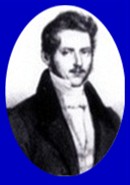
of Alessandro Nini. Born on
November 1, 1805, Nini was largely self taught. His early career was quite
eventful including a spell of 5 years teaching in St Petersburg. The very
Germanic ♬ horn introduction
to
Act 2, Scene 3 of La marescialla d'Ancre shows
how Nini was influenced in his travels across Europe.
He
returned to Italy in 1837 taking up a post in Novara in 1839 and
eventually, in 1843, moving to Bergamo to assume, on Mayr’s death, the
positions of Maestro di Capella of Santa Maria Maggiore and director of Mayr’s school, at
which Donizetti had studied. He remained in Bergamo for the rest of his
life, dying there in 1880, although he had, by then, been manoeuvred out
of the position of director of the school.
Nini is largely unknown today, but between 1837 and 1847, he
wrote 7 complete operas plus several incomplete efforts and had some
success with them, particularly with La Marescialla d’Ancre (1839),
considered his best, and Virginia(1843). From then on he seems to
have occupied himself with his passion for religious music. Probably the only piece of his to
have been recorded thus far is the Ingemisco in the multi composer Requiem
for Rossini that was organised by Verdi (Lyrica, LRC 01027). The resurrection of La Marescialla d’Ancre was
the first Nini opera heard for around 150 years.
As with many Italian operas of the day, La Marescialla
d’Ancre was based on a French play, in this case Alfred de
Vigny’s La Maréchale
d’Ancre, first performed in Paris in 1831. The play, in turn, was built on
historic foundations, the murder or execution in Paris of Concino Concini
and his wife Leonora Galigai, the marescialla of the title, the power
behind Maria de’Medici, the mother and Regent of the young Louis
XIII. The libretto was by
Giovanni Prati, who was to become better known as a poet of the
Risorgimento. It was his
first attempt and this may well account for the libretto’s lack of the
conciseness.
Even though Nini did not set the full libretto, cuts soon seem
to have become the order of the day and the opera suffers some weakness in
its dramatic structure, which were papered over reasonably effectively in
the Jesi production. As so often, extra characters were added in the play
and the opera to turn an essentially political tale into one motivated
more by love interest. Michele Borgia (not apparently
anything to do with the Borgias), Leonora’s first love, turns up at the
French court with his wife Isabella Monti. Borgia has made common cause with
the Count de Luynes to get rid of Concini but, on finding that Leonora is
married to Concini, now wants to extricate her from the impending
disaster. In the meantime,
Concini has become attracted to Isabella and the ensuing recriminations
lead to a fine quartet towards the end of Act 1.
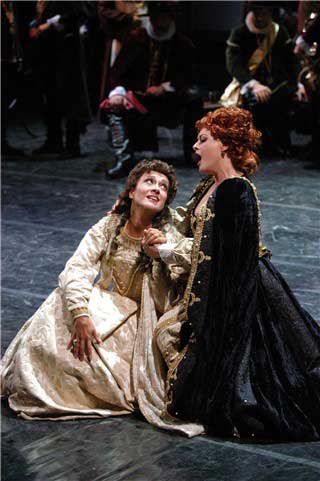
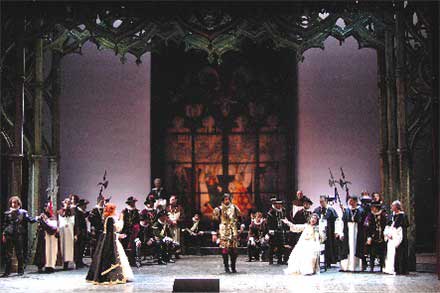
In Act 2, despite pleas from Borgia and Leonora, Isabella is
persuaded to testify against Leonora at her trial for witchcraft and there
is a riveting scene between the two women at the trial when Isabella,
after great torment, declares Leonora innocent. Unfortunately this scene leads
nowhere dramatically when de Luynes then produces a warrant for Leonora’s
death signed by Louis XVIII, who has taken over power from his mother.
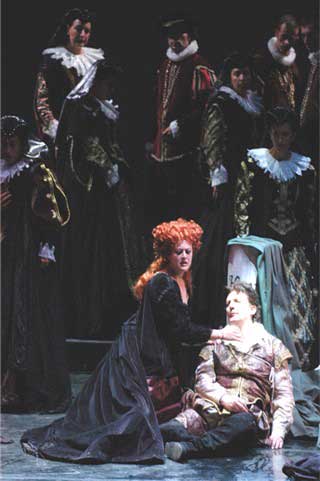
Concini in the meantime has met and been killed by Borgia. Leonora
takes leave of her children, urging the elder to take revenge and there is
a rousing final scene as she goes off to execution.
Whatever dramatic flaws there might have been, there can be no
denying that Nini lavished some powerful and memorable music on it. While
there were occasional echoes of Bellini, particularly Norma, and of
Donizetti, the music was anything but derivative and the orchestral
texture, in particular, was sophisticated and original, perhaps reflecting
Nini's exposure to wider European influences in his travels. The most intriguing number was the
Act 1 quartet ( ♬ Part
of the quartet ) which had the energy and pulsating rhythm to be mistaken for
early Verdi and once again reinforces the point that, in his early years,
Verdi was using the same musical language as his peers even if he wielded
it with a firmer sense of the dramatic and with a truer melodic gift.
In fact in a revival in 1851, a member of the orchestra complained
that some of the music was copied from Verdi, only for Nini to point
out that his opera had premiered before any of Verdi's.
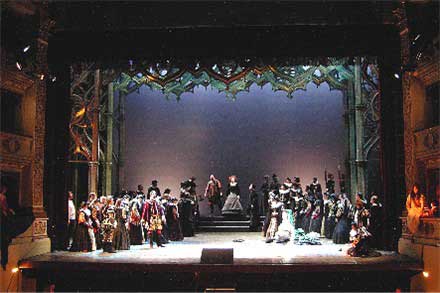
Jesi did Nini proud with a traditional but well thought out and
executed production from the team of Michele Mirabella (director), Paolo
Calafiore (set design) and Paolo Rovati (costumes). The lead singers were generally
excellent: Chiara Taigi, dramatic and thrilling in the title role,
Maurizio Comencini ( Concini), forceful but lacking subtlety, Marzio
Giossi (Borgia) and Monica Minarelli (Isabella). Fabrizio Maria Carminati drew
vigorously energetic and at, times, beautiful playing from the Orchestra
Filarmonica Marchigiana, although occasionally he misjudged the volume for
the size of the theatre.
Bongiovanni recorded the performances and the CD is well worth getting both for
its intrinsic enjoyment but to help appreciate what has, hitherto, been an
unknown link in the evolution of Italian opera.
|
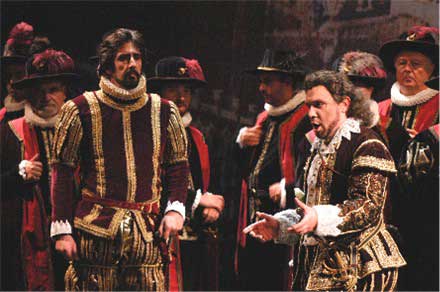
The Count de Luynes
(Francesco Palmieri) and
Michele Borgia
(Marzio Giossi)
plot Concini's downfall.
|
|
|
|
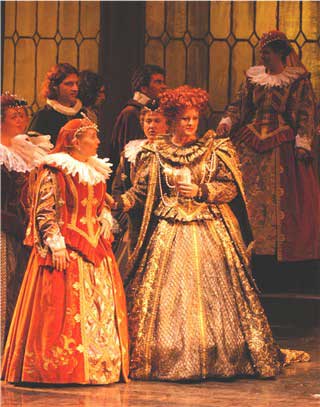
Leonora (Chiara Taigi)
|
|
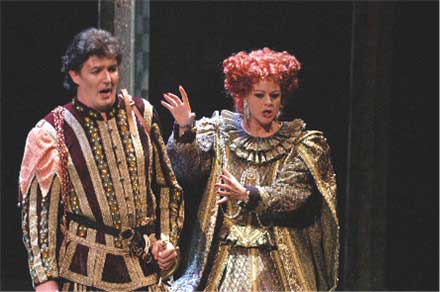
Leonora confronts her
husband Concino Concini
(Maurizio
Comencini)
|
|
|
|
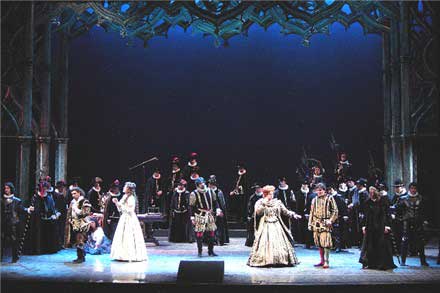
The Act 1 finale quartet :- Borgia, Isabella Monti (Monica
Minarella), de Luynes, Leonora, Concini and the chorus
♬
Part
of the quartet
|
|
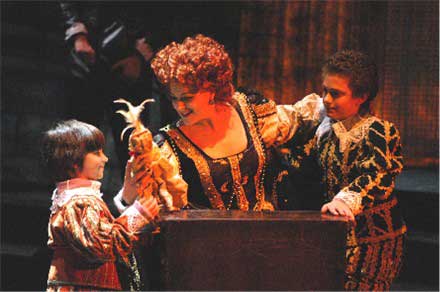
Leonora with her two children
|
|
|
|
Isabella refuses to accuse Leonora before de Luynes.
|
|
|
The death of Concini
|
|